Tag Archives: brioche knitting tutorials

Red Alder Classes Wrap Up and Eastern Uncrossed Brioche video

I had a great time at Red Alder Fiber Arts Retreat. I taught 4 classes, took 2 classes, and learned a lot from all of it! I was pretty brioche- and pooling- centric for all of it.

Let’s talk stitch mounts!

With conventional western style knitting, the right leg is on the front of the needle. This is true for both English throwing and continental picking methods. Both stitches are worked through the front loop, and the yarn wraps counterclockwise around the needle.

With eastern combined knitting (usually continental, yarn in left hand), the knits are formed conventionally, and the purls are wrapped/caught clockwise, resulting in the purl stitches mounted with the left leg on the front of the needle. For knitting in the round, the purl stitches would need to be purled through the back loop so the bottom of the previous stitch isn’t twisted. If knitting flat, the back of the purl stitch is a knit stitch, and it would need to be knit through the back loop to untwist the stitch.

Amanda in my beginning brioche class is a continental Eastern Uncrossed knitter. This means that she makes her all of her stitches with the yarn going clockwise around the needle (both knits and purls), which results in the left legs of all her stitches mounted on the front of her needle.

It took a little thinking, but we figured it out, and I made a video for 2 color Eastern Uncrossed brioche in the round.

Eastern Uncrossed brioche rib in the round

That helps me teach, and that helps knitters not have to change their knitting style when learning brioche. Win-win! Now I’m thinking about eastern combined knitting in the round; there are a couple ways to think about that purl stitch. I’m saving that for another day.
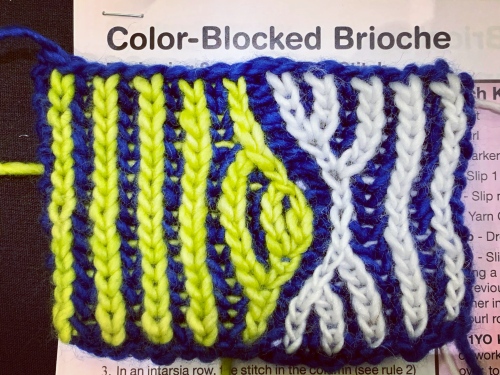
Color Blocked Brioche

I took 2 classes from Xandy Peters. The first was Color Blocked Brioche. If he had named it Brioche Intarsia, would I have signed up? Probably not! But color blocked intarsia in brioche is fun. Food for design thought.
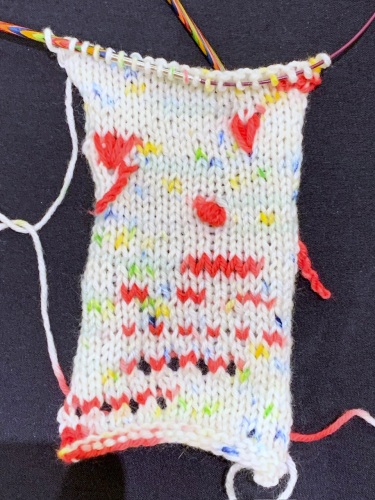
The other class was Stitch by Color. I didn’t bring the right yarn for this; my yarn just has one pop color, and sprinkles (not enough) of other colors. I’ve been on the pooling train for a year, and that’s the way I was thinking. What I really should have brought is a space dyed yarn that has longer stretches of several colors. Then I could pull out one color to accentuate, or eliminate (by concentrating it on the wrong side of the work). Here’s an example from Xandy.
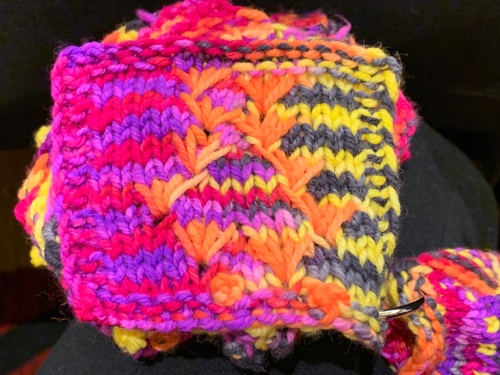
Stitch by color!

All of these colors are in the yarn; the pink and red you see on the left edge of the work are emphasized on the wrong side behind the yellow and gray, and vice versa. A great way to accentuate what you like, or hide what you don’t like! We learned some fun pooling stitches, too.
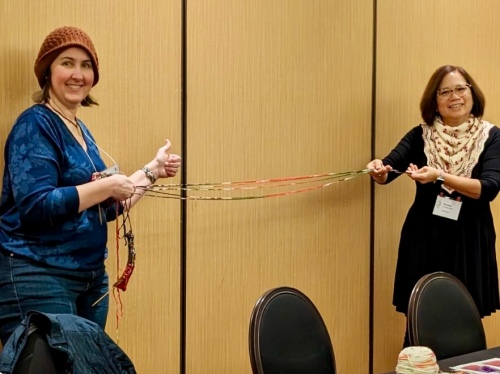
I helped my classmate recreate her dye skein so she could see where the color repeats were made.

Mt Rainier sunrise

That’s the teaching/learning part of the wrap up. There’s still the shopping! I came home with a few treasures. Still trying to catch up from Red Alder AND VKLive NYC!
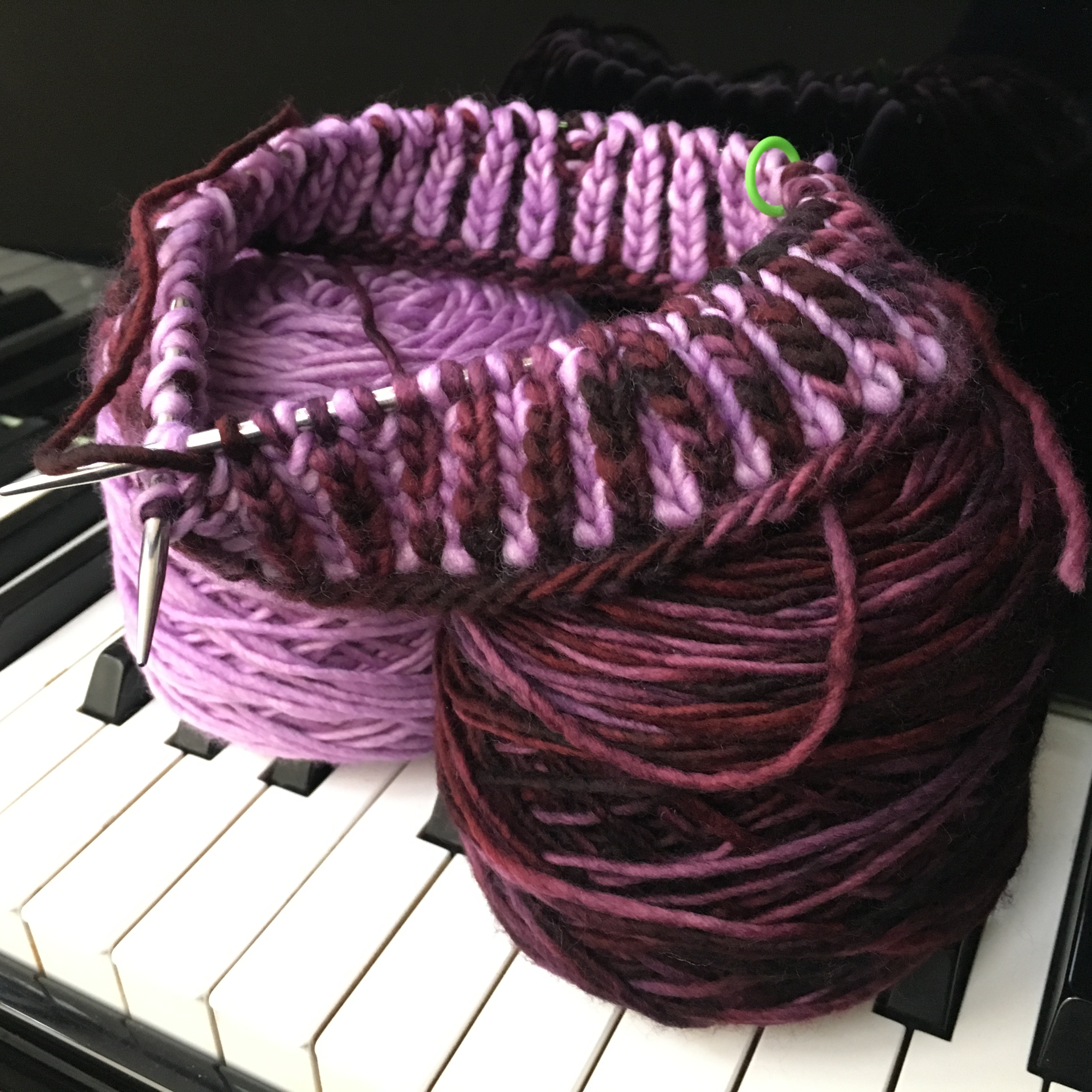
Tinking Brioche Decreases tutorial

A student asked me how to tink brioche decreases. I made a little video so I can share it with all of you, too.

Also, my Petite Brioche class through Twisted on September 26 is full!

So we added another class on October 17. Link to register is here.

There’s still room in my Syncopation class on October 3, link here.

Let’s knit!

Petite Brioche update: beginning and end of rounds

I’ve just updated my Petite Brioche pattern. I’ve been teaching this class a lot lately. The beginning/end of the round is always the most confusing spot for new brioche knitters, so I wanted to make it easier. I think this does. Also, it makes teaching easier for me, too!

Of course, the pattern links to video tutorials, so I had to make new tutorials! The new pattern has new links, my tutorials page has new links, and my handouts are getting new links. A lot of work for a free pattern, but it’s a labor of love for this brioche evangelist.

English/throwing

Continental/picking (I’m a very awkward continental knitter, but you’ll get the idea)

The older videos are still linked on the tutorials page; they still work. You can pick whichever makes sense with the way you think and knit. The Brioche Hat Trick patterns aren’t being updated; you can choose which way you want to work your beginning/end of rounds.

Hope this helps!

Did you ever wonder, brioche selvedges edition

I was wondering about the different ways knitters deal with the edges of flat brioche knitting. Two color, because that’s what I dream about, always.

When I first learned to knit brioche flat, I learned it with a garter stitch selvedge edge. I didn’t like it, because it made horizontal stripes next to the vertically oriented brioche.

Then I went to Nancy Marchant’s book Knitting Brioche, and there was an option for a one stitch selvedge edge, and this is how I’ve been doing it, mostly. There’s a little dance of yarn at the stitch before the first and after the last CC stitch on the CC color rows, after/before slipping the MC stitch at each end.

I took another class, and the teacher said to just leave that next to last stitch yarn where it was, no dancing yarn. It seemed to work fine, too.

So why the dance? I have some time on my hands (#socialdistancing), so I decided to find out.

Can you see a difference between the stitches in the red circle (yes dance) and the stitches in the blue circle (no dance)?

https://youtu.be/5TOqbhLCFhQ

Here’s a video so you can see it all in action.

Still teaching, even though I’ve canceled all my classes for the time being! Just doing it from a distance.

Have fun!

A Tale of Two Decreases

I just made a video tutorial for an alternate version of a left leaning brioche decrease.

The center decrease shown is a right leaning decrease. The one on the right is a left leaning decrease, and it’s fine for most purposes. But it shows a lot of the dark colored wrap of the stitch that is passed over. Most of the time, this doesn’t bother me.

But sometimes, like in my Aspen Leaf scarf, I want the left and right leaning decreases to mirror each other more closely.

The Brioche Unwrapped Decrease moves that wrap out of the way before passing the slipped stitch over. Very tidy! Thanks to Xandy Peters for dreaming this up. I’ve made my own video tutorial, because I want to make sure it will always be available when I link to it in a pattern.

Brioche Unwrapped Decrease tutorial link

Here you go! If you don’t like the unwrapped decrease, you can always use the other left leaning decrease. You’re the boss of your knitting!

Fixing Brioche Knitting Mistakes

I’m planning to teach a brioche knitting class at Stash in Corvallis on June 2, and at Oregon Flock and Fiber Festival on September 22. This is a three hour class, so it goes beyond the two hour Petite Brioche class that I’ve taught at Twisted.

I’m using my Heliotrope hat as the basis for this class, but I want to start with a bit of brioche rib before getting into the increases and decreases that create the leafy patterning. I may change the top of the hat too. We’ll see when I get to that part on the sample I’m knitting!

I love this color combo. While I’m knitting the sample, I’m taking the opportunity to make some video tutorials. Here you go!

Here’s my original Petite Brioche tutorial; I’m including it here so everything is one one easy page. I’m carrying my yarn in my right hand (English/throwing style).

Petite Brioche for continental knitters. I’m not the most adept at the left hand carry, but I wanted to show something that works with my Petite Brioche instructions. I think this does.

Where’s my YO? What to do if your YO goes missing from your slipped stitch.

And then I made a mistake not on purpose! So while I was fixing it, I made a video for that, too.

How to fix a brioche mistake, two rounds down. Yes, I did it, repeatedly, and lived to tell the tale.

I hope these are helpful to you!

Are you knitting brioche? You can give it a try with my free Petite Brioche pattern! And now you can fix your mistakes, too.