I’ve been knitting in circles so much lately, so many hats and cowls. One benefit? I’ve perfected my circular join. I used to cast on one extra stitch, and then knit the first and last stitches together. This snugged up the join, and it still will.
But I’ve started using that extra stitch in a different way, and it’s just a bit tidier. I really like the way it looks. I take the last stitch cast on, and pass it over the first stitch that I cast on. I made a video for you!
You do still have to remember not to knit with the tail…
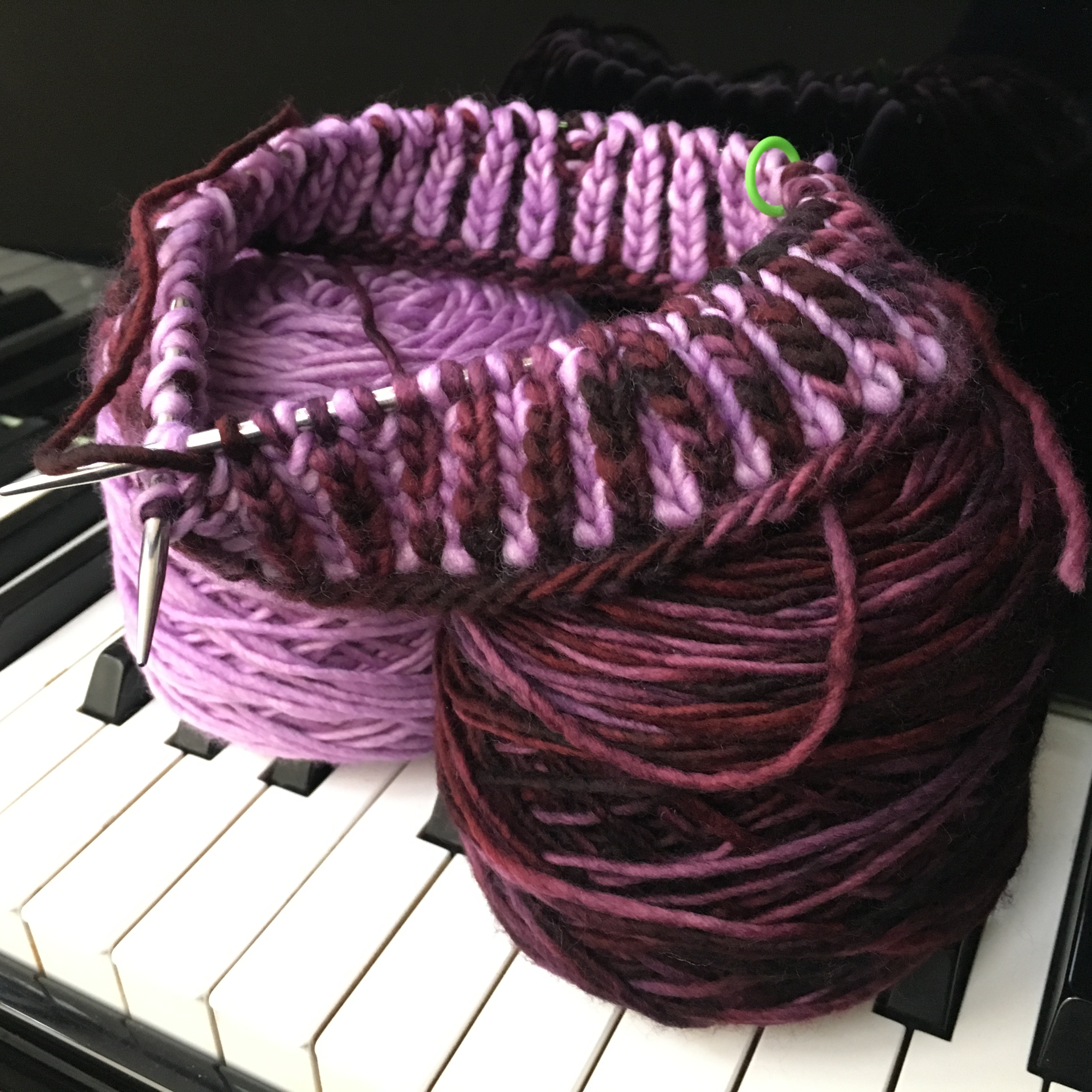
Is it possible? Can you frog brioche? Of course. It’s getting it back on the needle that’s tricky. I’m here to help! I’ve had a lot of experience frogging…(for newbies: frogging means rip-it, rip-it, rip-it).
You can rip one row/round at a time, alternating colors, but it’s just as easy to rip them simultaneously. The trick is to rip until you’re close to where you want to end up, and then tink (un-knit, knit spelled backwards) the last row or round, one stitch at a time, picking up each stitch as it’s freed from the yarn. This is also how I frog regular knitting.
After I made this video, I frogged this project completely, because it’s a little too big. But I wanted to show you how it worked, before completely undoing it. It turned out to be just a big swatch!
I’ve just updated my Petite Brioche pattern. I’ve been teaching this class a lot lately. The beginning/end of the round is always the most confusing spot for new brioche knitters, so I wanted to make it easier. I think this does. Also, it makes teaching easier for me, too!
Of course, the pattern links to video tutorials, so I had to make new tutorials! The new pattern has new links, my tutorials page has new links, and my handouts are getting new links. A lot of work for a free pattern, but it’s a labor of love for this brioche evangelist.
English/throwing
Continental/picking (I’m a very awkward continental knitter, but you’ll get the idea)
The older videos are still linked on the tutorials page; they still work. You can pick whichever makes sense with the way you think and knit. The Brioche Hat Trick patterns aren’t being updated; you can choose which way you want to work your beginning/end of rounds.
I promised a video tutorial to 3 of my classes at the last Virtual VKLive, and I made one and sent it along. But I just re-made it with more descriptive detail. Here’s the link on YouTube.
I learned this technique from a video by Nancy Marchant, and then expanded on it as I learned how and why it works. Just another tool in the brioche toolbox!
I put a link to this video on my tutorials page, so you don’t even have to remember where to find it. And if you didn’t know I have a tutorials page, go check it out. I have lots of tips over there, and I’m getting better and better at making videos.
My brioche classes are sold out at VKLive, but you can take brioche classes from me at the Peacetree Fiber Adventures online retreat on July 24 and 25. Register here.
There’s still room in my Minerva Entrelac scarf/cowl class at Virtual VKLive. Register here!
Oh, that last bit, the right edge triangle. It sounds a little tricksy at the end, but it’s not hard. Just keep following the directions, to the end, which is a slightly tricky part. Here’s a video for you:
Then it’s on to Tier 3, which is a piece of cake! 🍰
When you’re finishing Tier 4, with another right edge triangle, picking up the last stitch can be a little tricky. I like to pick up here, in the outside of the first V on the outside edge, so the corner of the triangle doesn’t stick out as a bump on the lovely straight edge.
Now it’s just a matter of knitting away and watching your colors change. Have fun!
If you’re on Ravelry, please make a project page for your Minerva; I’d love to see them there. Ravelry makes it so easy to find them all together. And post on Instagram using #minervakal2020 and #pdxknitterati too. I love seeing your progress.
How are your base triangles looking? Not really triangles, are they? But they’re close enough, and they’ll look good as we go on.
I forgot to ask: If you’re on Ravelry, please make a project page for your Minerva; I’d love to see them there. Ravelry makes it so easy to find them all together. And please post your progress on Instagram using #minervakal2020 and #pdxknitterati so I can see them there, too.
Here’s a short video on how to start the left edge triangle.
And here’s a video on picking up stitches for the first right leaning rectangle.
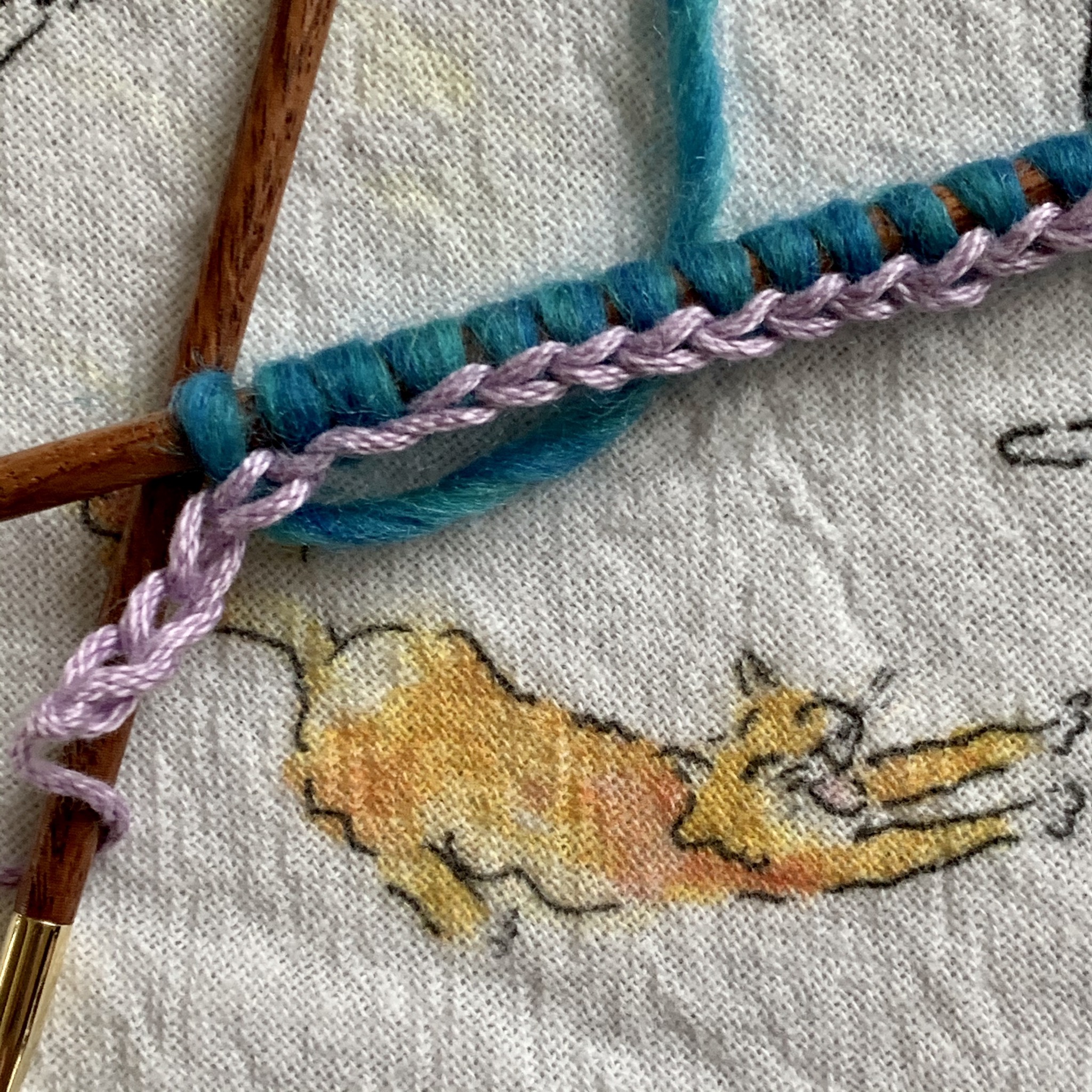
I used a crochet chain provisional cast on. If you’re doing it right, you’ll see the chain. See on the last 3 stitches, I did it wrong? Don’t do that!
Here’s a short video to walk you through the beginning of the first row.
And a video of the transition between the first and next triangle.
Let me know how you’re doing with your project; post on Instagram and use #minervakal2020 and #pdxknitterati so I can see them. And please make a Ravelry page for your project if you’re a Raveler; I love being able to check in on your projects. And post on your blog if you’re a blogger and let me know!
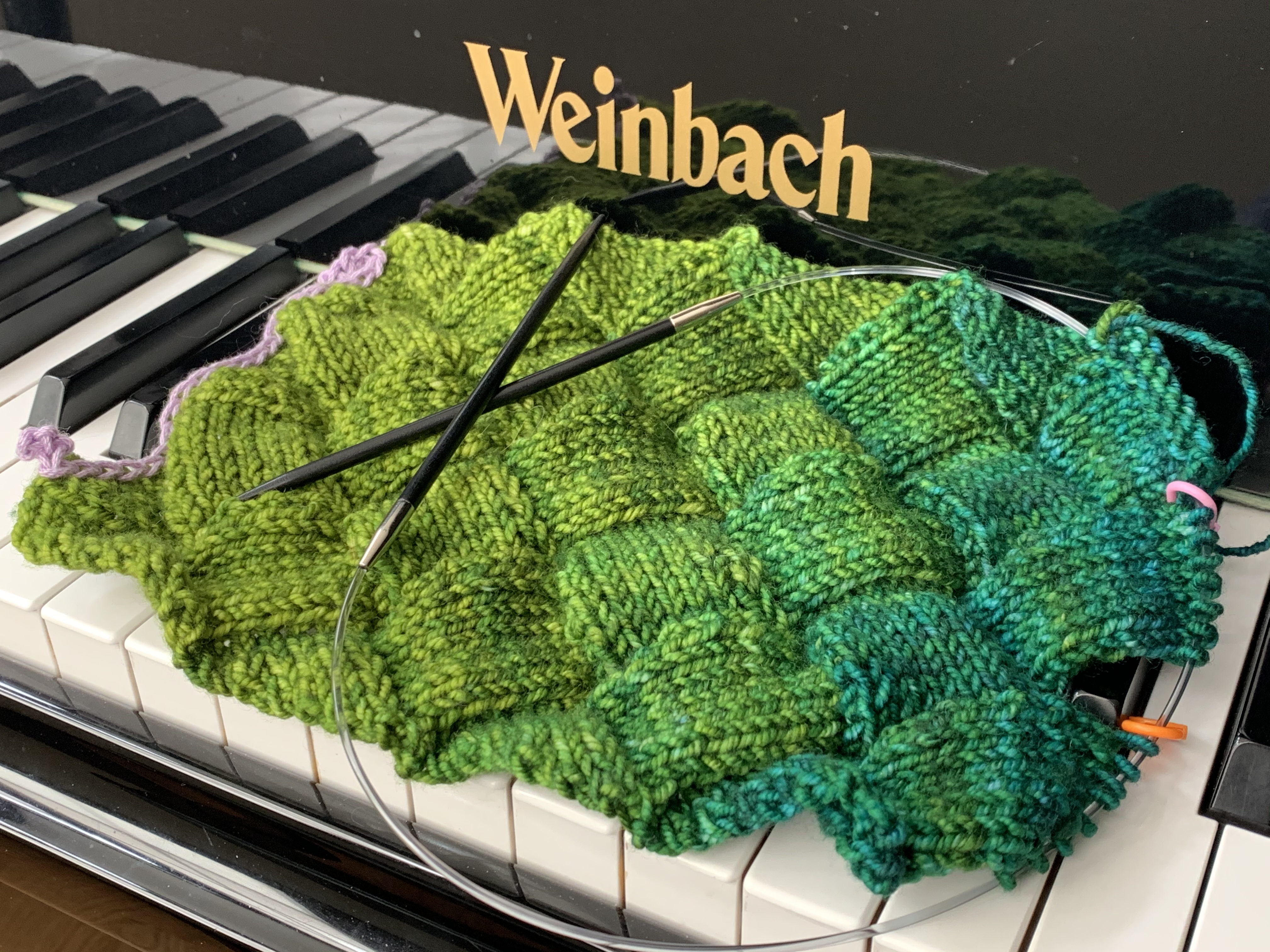
I’m using a bit of Knit Picks Chroma Worsted, I think in Pegasus, to show you this beginning, because I already used my Huckleberry Knits Gradient to do a little knitting last night. I had a Zoom meeting with the knitters who were going to come to my Minerva class that I had to cancel, so it’s a bit ahead of where we are right now.
Biscuit helped me set up my workspace. She was ready for her closeup, under the warm Ott light!
We had a good meeting, but it sure is a lot harder to have a knitting class when you can’t touch the other people’s knitting! And one on one is easier than a large group. So in a pinch, Zoom for sure. But I’d always choose in-person over virtual meeting, if possible.
Ready to cast on? Almost! Are you planning to knit a cowl, or a scarf? It’s good to plan your ending before beginning.
Photo by test knitter Paula Sadler
If you’re planning to knit a scarf, you can just begin with a long tail cast on. The first row after that is a purl row, because when you turn to knit back after casting on, you’re looking at the bumpy purl side of your cast on. We’re knitting stockinette based entrelac, so we want all those purl bumps on the back! By purling the setup row, we’re getting ready to work from the public side, the right side, the knit side.
If you’re planning to seam your Minerva into a loop cowl, I’d recommend beginning with a provisional cast on. When you’re finished knitting, you can pick up the live stitches from the provisional cast on, and use these with 3 needle bind off to join the beginning to the end. I did this with my Noro Minerva; I’d always rather knit than sew!
The crochet chain provisional cast on is my favorite provisional cast on. I made this tutorial back in 2012; it’s not as pretty as more recent tutorials, but it still works! You can use whatever provisional cast on you choose, though.
And if you just use a long tail cast on because you thought you were knitting a scarf, and somewhere along the way you change your mind? You can also pick up stitches along the cast on edge, and join those to the end with a 3 needle bind off. It’s a little bit tighter, though, so I didn’t love doing that (on the 2 Chroma cowls). I used an elastic bind off, in combination with the 3 needle bind off, to make the seam more flexible. But that’s for later!
OK, let’s go! Cast on, and purl your setup row. We’ll go from there.
Planning for a Minerva KAL cast on tomorrow, which is Wednesday. Is anyone else having issues of not knowing what day it is, while working from home? What yarn are you using? Color changing? Or do you want to do stripes and sew in all those ends? Knitter’s choice!
While you’re off picking yarn for Minerva, let’s have a look at some brioche. You know brioche is never far from my mind.
If you’ve become comfortable with 2 color brioche rib, you may be wondering what else can you do with it. Let’s syncopate!
What is syncopated brioche? It’s a simple switching from brioche knit to brioche purl, or vice versa, within the row or round. What happens when you do that?
This! See where I changed from knitting with the blue yarn in the rib stitches, to purling with the blue yarn at the leafy border? The blue purl stitches sink into the background in the border. And I switched from purling with the yellow yarn in the ribbing to knitting with the yellow yarn at the leafy border. The knit stitches always stand out more than the purl stitches in brioche rib, so the knit stitch yarn will be your featured color.
Here’s the back of that same sample.
And here’s where two edges meet on my Syncopation Shawl, the leafy side border and the wide ending of this asymmetric triangle shawl.
Find my patterns on Ravelry: Michele Bernstein Designs
Here are some of my favorites, and the newest. Many of my designs are also available through my Payhip store.










 PDXKnitterati