Tag Archives: History

Rhône cruising in Provence

I was very sleepy when I wrote the previous post; I’ve gone back and added a little explanation about the establishment of the silk industry in Lyon, and also a video explaining designing for the Jacquard loom. Go back and check it out if you wish!

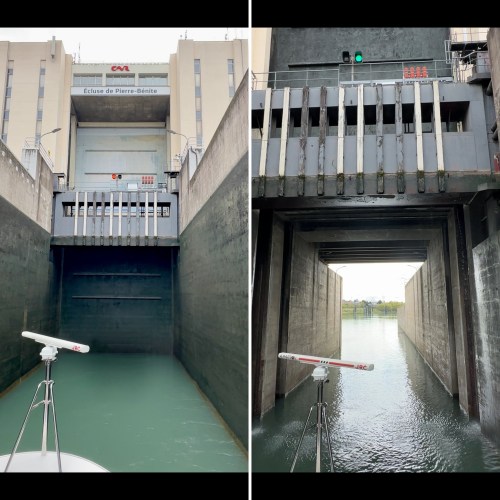
We spent seven days on the Rhône River on the AmaWaterways Colors of Provence cruise. The AmaKristina can carry 156 passengers; we had 126. It’s very different from ocean cruising because of the size; things are on a smaller, more intimate scale. We went through 12 river locks on this trip; that was very interesting! Many of the locks are also hydroelectric dams.
River lock, closed and open
The first of 12 locks, closed (we dropped 10 meters) and open

I hadn’t realized how much the name Rhône shows up in things I’ve heard of. Côtes du Rhône wines, or banks of the Rhone. There are a lot of wineries, mostly Syrah grape in the section we cruised. Valrhôna chocolate, which is based in Tournon. The ViaRhôna, a bike path that will eventually go from Geneva to Marseilles (we rode on just a bit of this for one of our excursions).
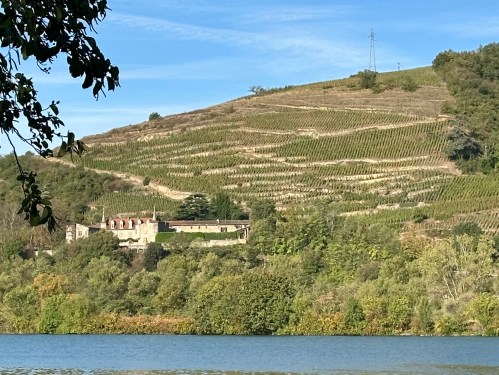
Vineyards along the Rhône in Vienne, as seen from our bike ride

I wish we had a little more time in Vienne. We opted for the bike ride on the ViaRhôna, but that meant missing a walking tour that included the 1st century Roman Temple of Augustus and Livia. Well preserved, because it has served as many different things during the ages: a medieval church, Temple of Reason during the French Revolution, 19th century courthouse and library. (Thanks, Smithsonian lecture!)
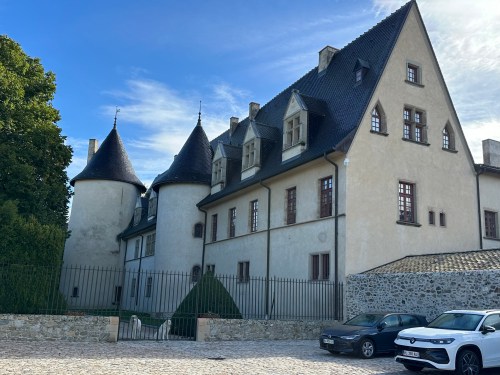
Chateau d’Ampuis, Domaine Guigal

Also seen on our ride. The left tower dates from the 14th century, and the house from the 16th century. Living on the west coast of the USA, our house is old at 105 years. Quite a difference.
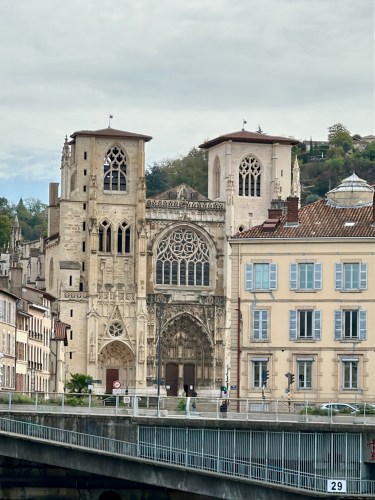
Cathédrale Saint Maurice, completed in 1529, as seen while cruising out of Vienne to Tournon
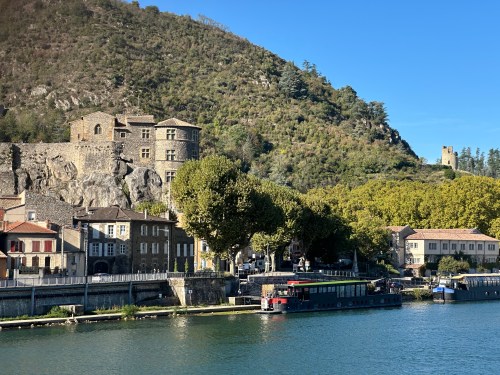
Château de Tournon

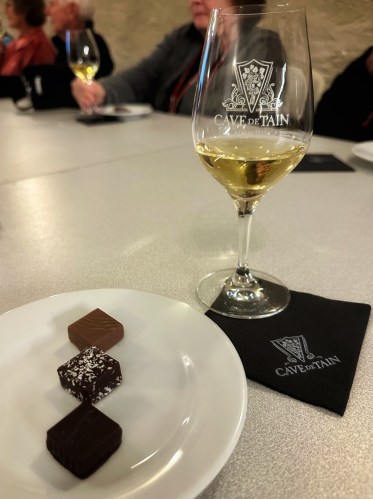
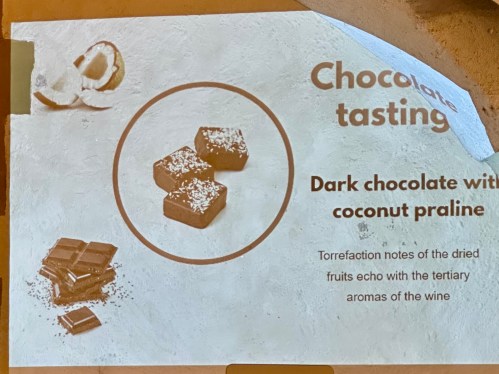
We had a wine and chocolate tasting at Château de Tournon. It was interesting to have a white wine with chocolate! I was the only person who said they didn’t like this wine; it was a Marsanne that had been barrel aged. I don’t like oaky whites. But pairing it with milk chocolate made it better for me. So, if you like something about a wine, you can pair it with a food that emphasizes that characteristic, but if there’s something you don’t like, you can pair it with something that diminishes it. I hadn’t thought that hard about pairings before, just what I like or don’t like. Good to think about the why. PS that middle chocolate was amazing, dark chocolate with coconut praline. Perfect with the wine it paired with.
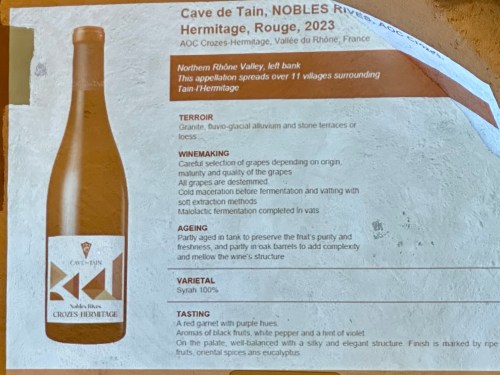
Wine notes
Chocolate notes. Wish I could have bought more of this one!
At Valrhôna Cité du Chocolat

We stopped by the Valrhôna gift shop, but didn’t take in the museum. Samples were delish! On to Avignon…

Big Dipper over the Rhône

We woke up in Avignon, and went on a food tour to Les Halles Market. Wine before noon? Why not?
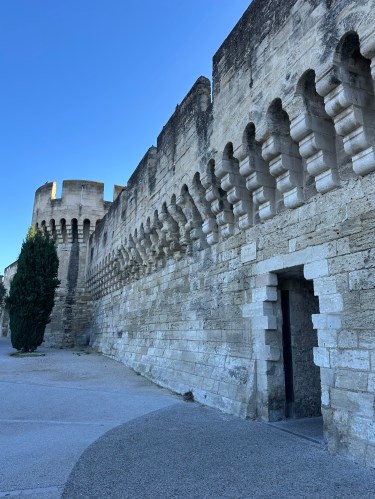
The medieval walls of Avignon
at Serge Olives

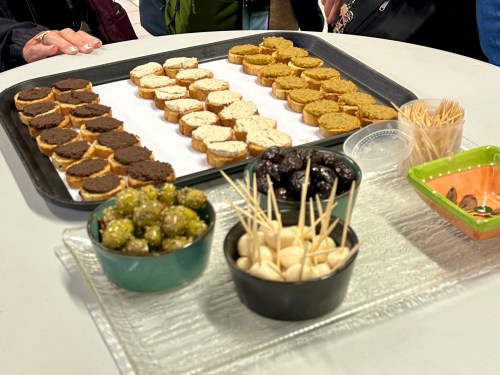
The Taste of Avignon began with olives and olive spreads. The garlic? Pickled for months, didn’t taste pickled, and it was delicious.
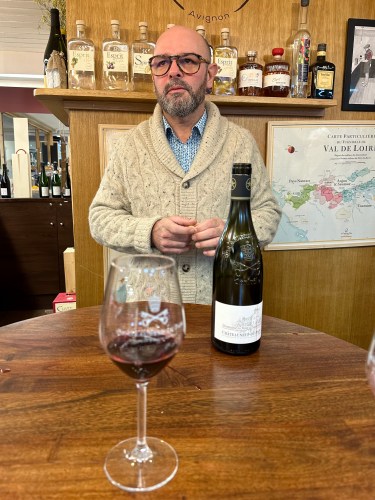
at La Cave des Halles

Next up, a very lovely wine. Chateauneuf du Pape, Domaine du Bois de Saint Jean, 100% Grenache.
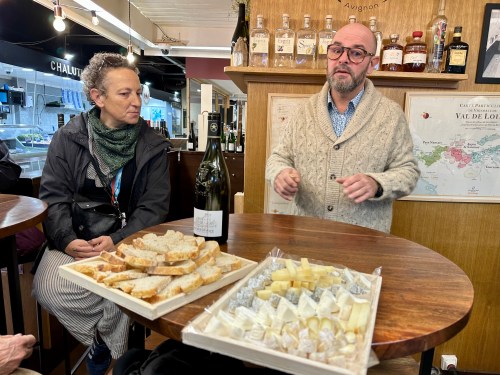
It was paired with cheeses from another shop. The rectangles towards the back are sheep cheese, and a little firmer than the 3 goat cheeses. All were fabulous, especially with this wine.

We also stopped at a shop that had cookies and candy on the way back to the ship. Nougat is a Provençal specialty; I bought some to share with my workout buddies at home.
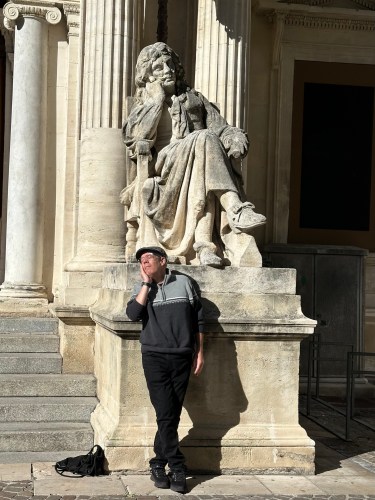
Theatre Avignon

We had some time to wander through the old town before heading back to the ship. There was a flea market in the square outside Les Halles.
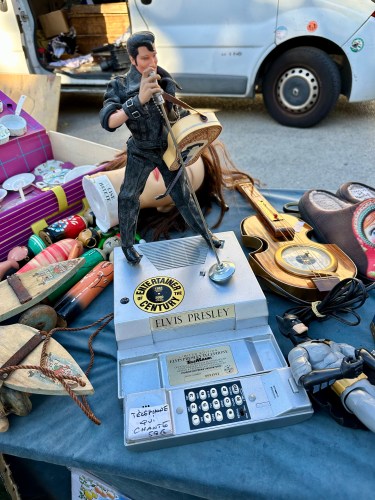
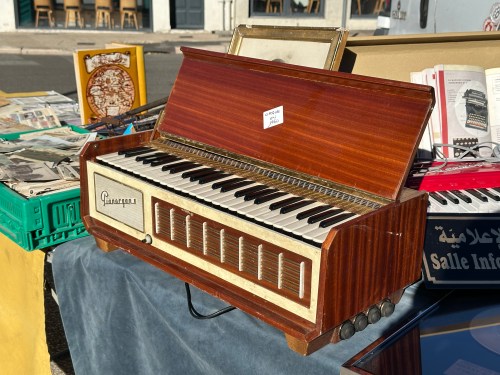
No room for these treasures!

In the afternoon, DH took a nap, and I went to see the Pont du Gard, a Roman aqueduct that was built to carry water from Uzès to Nimes over the Gardon River in the first century AD. The drop averages about a centimeter per 600 feet over 31 miles.
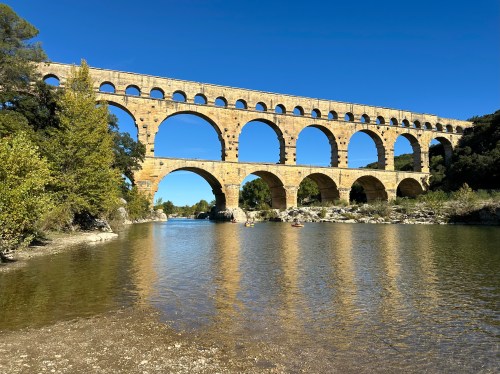
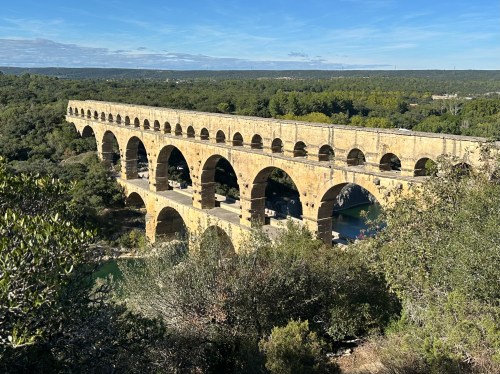
Pont du Gard on a beautiful day. Love those Roman arches!

I hiked up to the top with some new bike buddies from the day before.
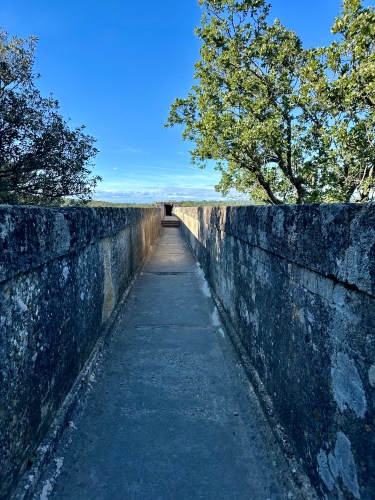
Looking through the gate at the top of Pont du Gard. No entry for us!
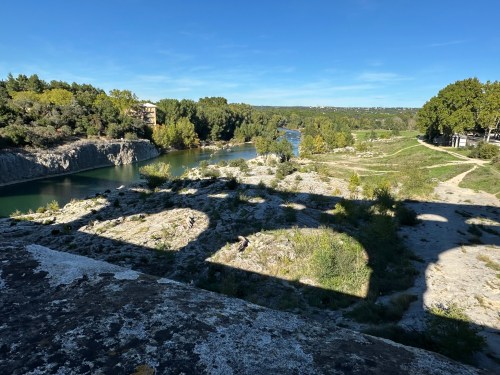
Quite the shadow

There were kayakers in the river; that looked like a fun expedition.
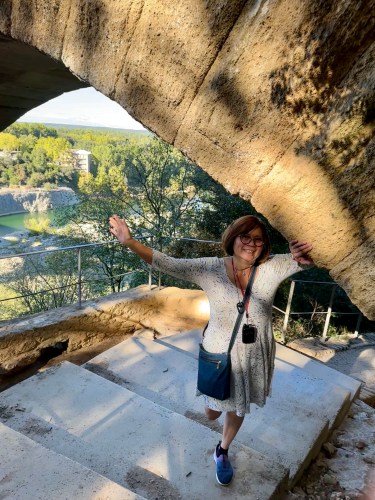
Touching one of the upper arches.

Is it old? YES.

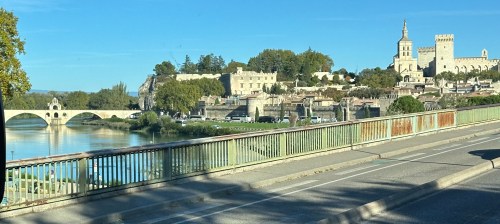
On your left! Pont Saint Bénézet

I struggled to catch a glimpse of the other famous bridge from our bus. I think we cruised past it early in the morning; I wish I’d known. Sur le pont d’Avignon, l’on y danse…It’s actually the Pont Saint Bénézet, made famous in the song. The first bridge here was built in the 12th century, and rebuilt in the 13th century. It washed out during floods several times, and it ceased to be usable in the 17th century. Four of the 22 arches of the rebuilt bridge remain.
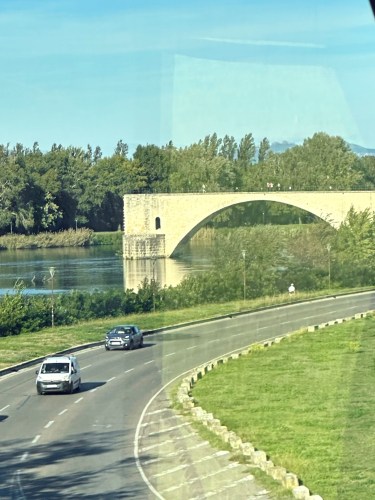
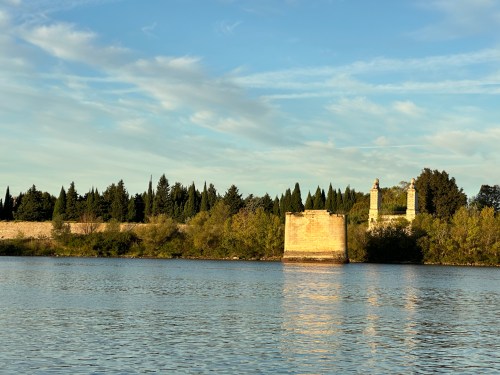
End of the bridge
Another bridge to nowhere, this time in Arles

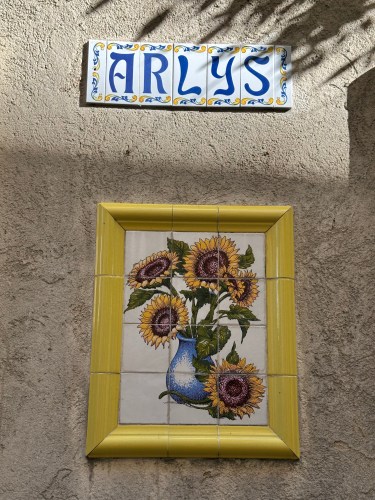
Or final stop was in Arles. We opted to explore the old town on our own in the morning.
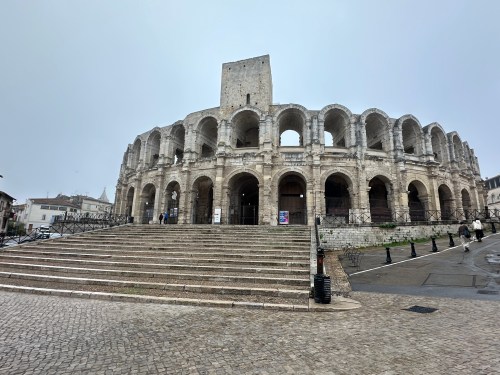
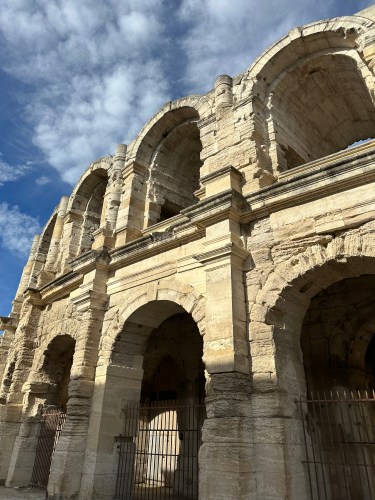
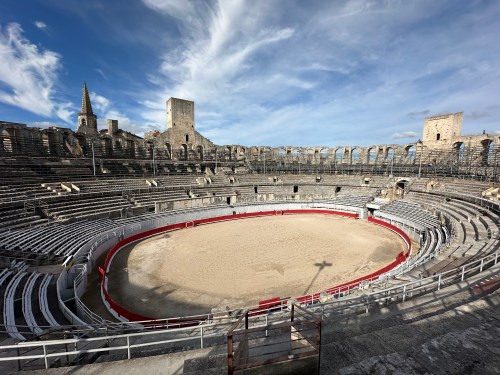
The Roman amphitheater is the centerpiece of the old town. It was built in 90 AD and can seat 20,000 people. There are still events held here, including concerts and bullfighting.
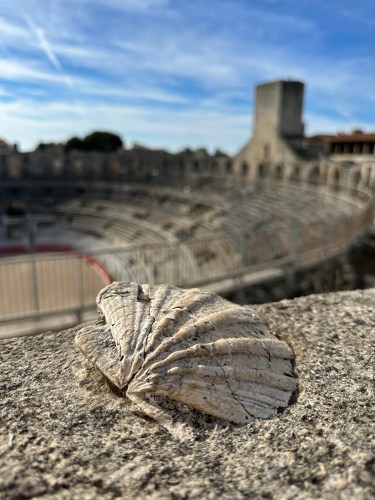
How long has this shell been here? Up on the tower staircase

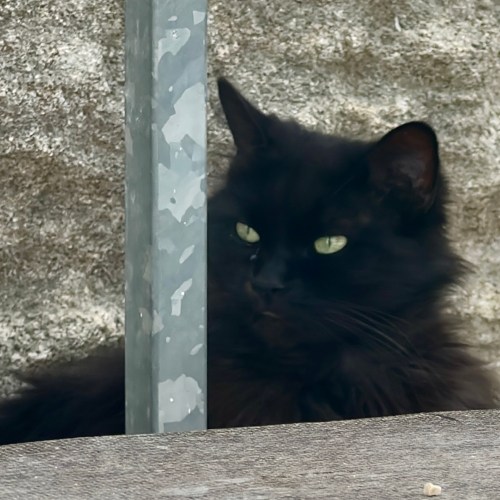
We saw an enormous cat here, larger than a typical house cat or feral cat. And this little black charmer.

We took a van Gogh-centric walking tour in the afternoon.
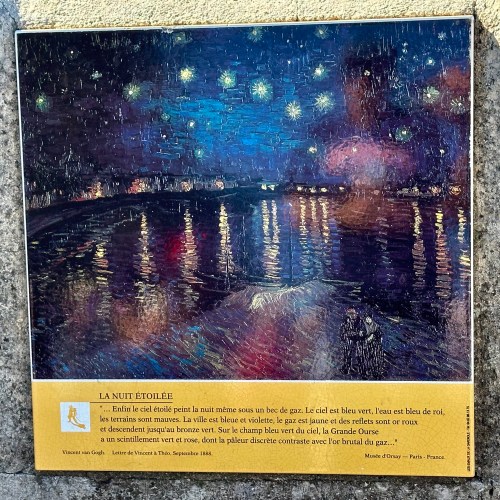
There are signs like this all over town, showing where van Gogh may have painted. This is on the bank of the Rhône, and it looks like he was as captivated by the Big Dipper as I was.
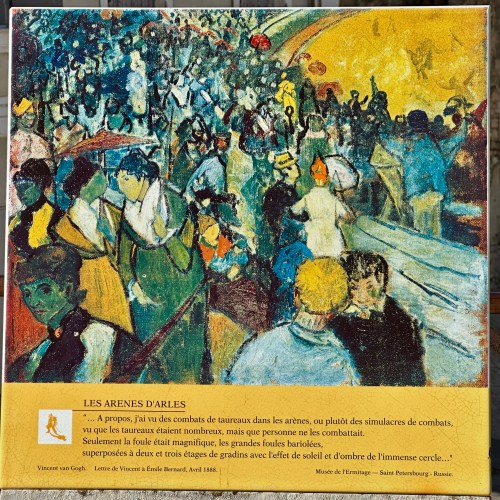
This one is outside the amphitheater. He was more interested in the people than the arena the painting is named for! Note the woman in green with the white scarf; this is traditional Arlesienne clothing. (Thanks, Smithsonian lecture!)
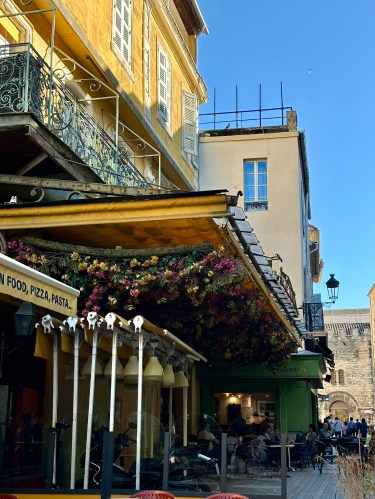
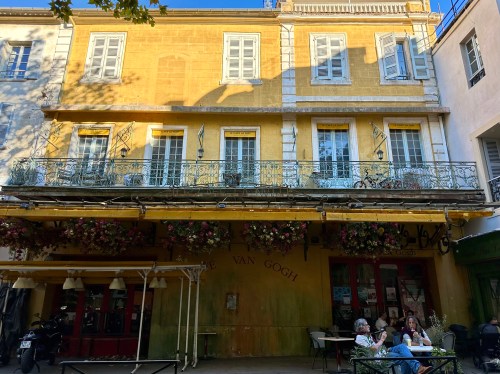
Site of Cafe Terrace at Night
that famous cafe, currently closed for renovation
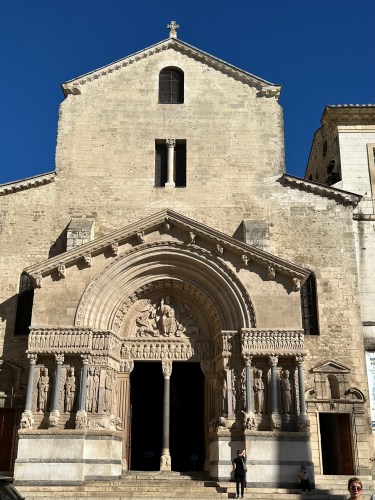
Church of St Trophime, Arles

This church was built between the 12th and 15th century, and is Romanesque architecture. The sculpture over the door is the Last Judgement. The columns are repurposed from older Roman buildings.
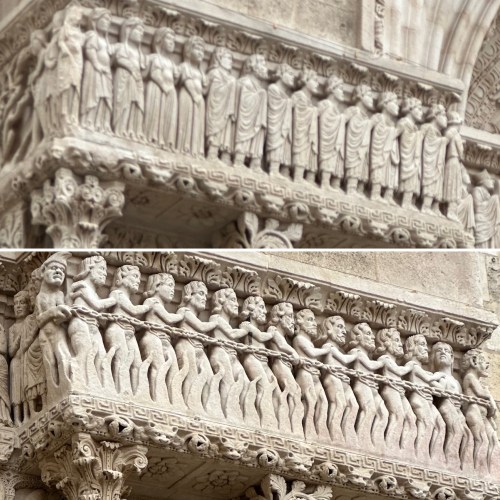
To the left of the portal you can see the saints going to heaven, and to the right you see the damned in chains, the flames of hell licking up their legs. If your populace was illiterate, it was a way to get the message across! (Again, thanks Smithsonian lectures!)
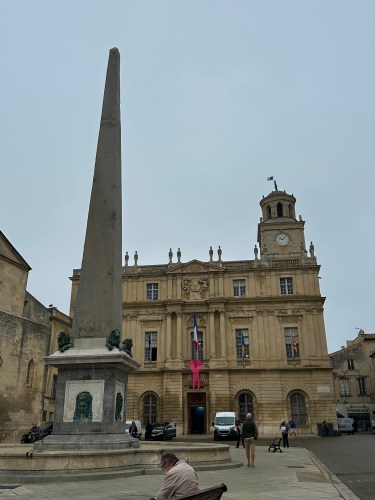
This is a pretty busy square (Place de la Republique), with the church, city hall, and a 4th century Roman obelisk. So much history!
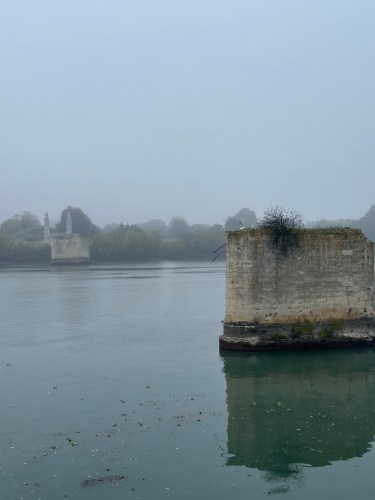
Our last morning in Arles saw a weather change. Misty. And the mosquitoes came in with the mist! We had a very swatty walk that morning, then headed to the train to return to Paris for our flight home.
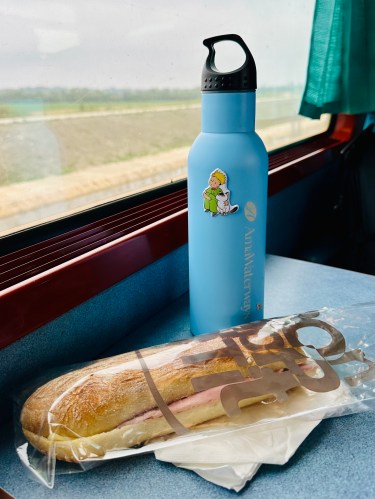
The first leg of our train trip took about 3 hours, and traced our way back up the Rhône to Lyon. Seven days, or 3 hours. The cruise was great! AmaWaterways had comfortable staterooms, great food, and well curated excursions, which were included in the price of the cruise. We’d consider doing another one…someday. (DH can tell you I took a lot of pictures of my food; it was so well presented, as well as delicious. But that’s a lot of storage space, so I’m not sharing them.)

Now I’m home and it’s time to get back to work. I’m teaching a class tomorrow at For Yarn’s Sake. Colorwork, one strand at a time. Guess I should get my materials together!
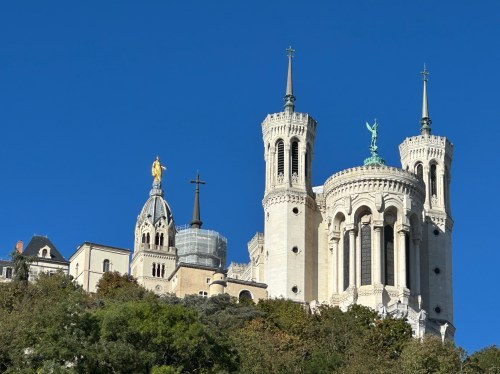
Lyon, city of silk

We went from Iceland to France, making our way to Lyon to board the AmaKristina for the Colors of Provence cruise. This was our first river cruise, and we really enjoyed it. The ship is a floating hotel, so after unpacking once you’re good for the week.

We took a walking tour of Lyon; it began with a bus ride to the top of Fourvière Hill to the Basilica of Notre Dame de Fourvière.

From there it was all downhill,

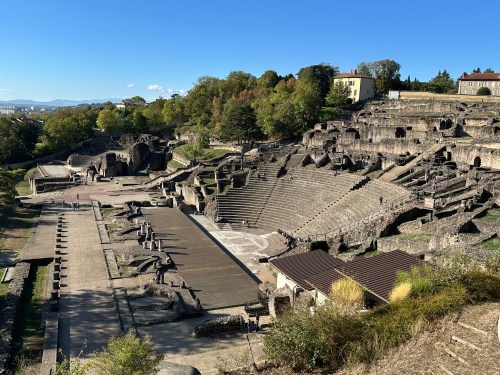
weaving past the Roman amphitheater (built in 15 BC), and through the Old Town, which is a remarkably well-preserved Renaissance district.

Henri IV honeymooned here
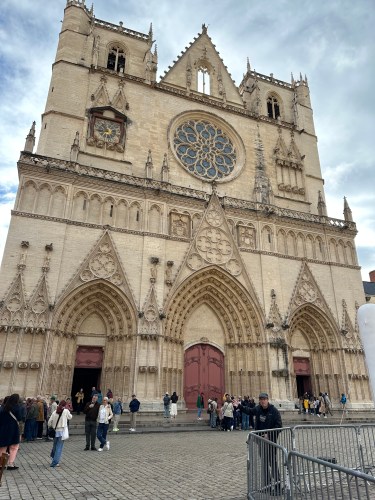
Cathédrale St John the Baptist
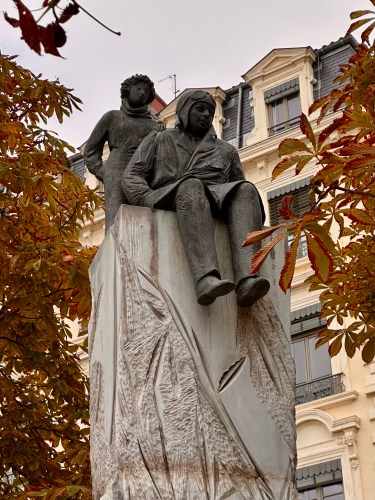
Antoine de St Exupéry and le Petit Prince statue on Place Bellecour

Did you know that Antoine de St Exupéry was from Lyon? Author and WWII pilot.

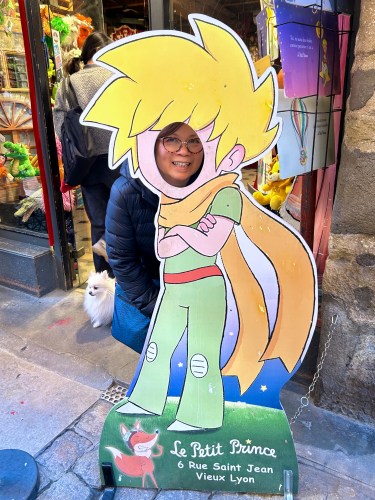
Je suis le Petit Prince

Note the little shop dog behind me. I came back the next morning and bought stickers for personalizing our water bottles.

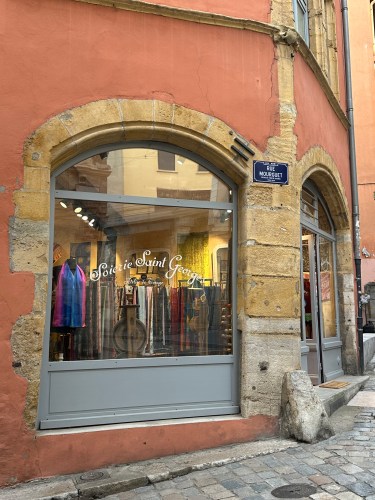
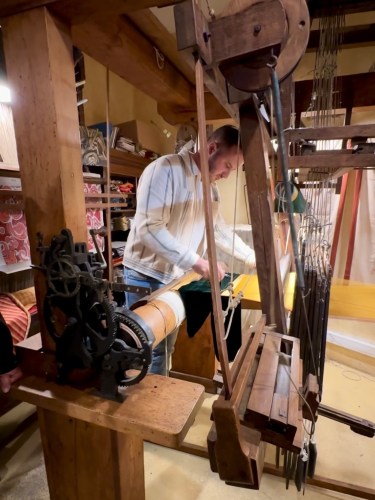
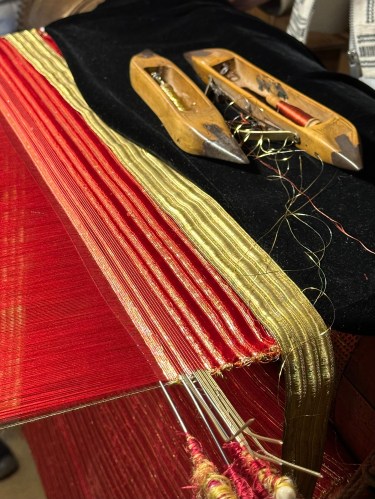
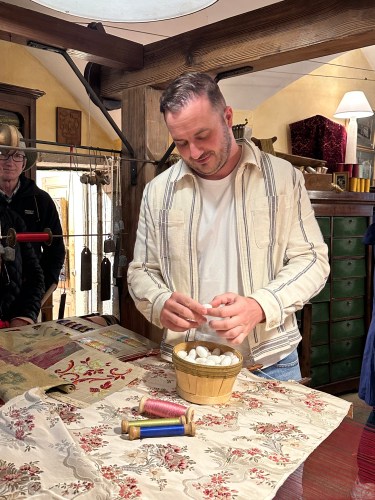
Silk production has been part of Lyon’s history since 1536, when François I gave the city a royal monopoly. My favorite part of the tour was a visit to Soierie Saint Georges. This silk shop has a workshop in the back, with Jacquard looms from the 1800’s. The family has been using them ever since. Some of their work is in the palace at Versailles.

1850’s loom

It takes 3 months to warp this loom.

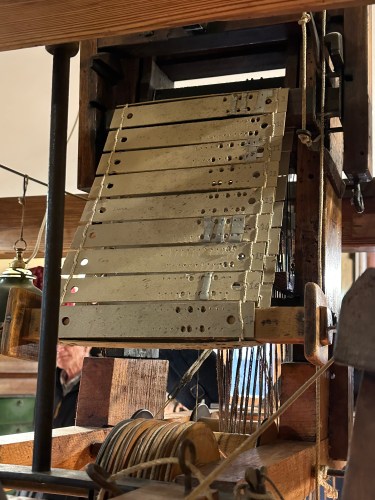
Jacquard loom punch cards on an 1820’s loom
Designing for a Jacquard loom

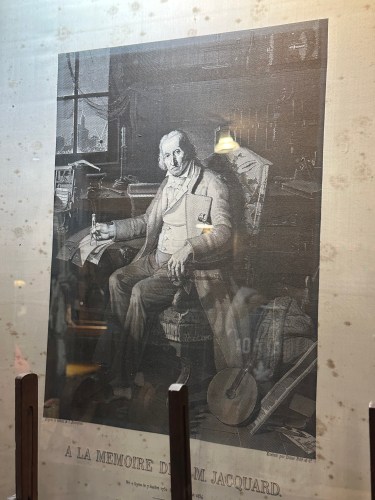
This portrait of JM Jacquard is actually a silk weaving, produced on a Jacquard loom.

Making velour the old fashioned way. Metal rods are inserted to make a taller weft fabric, which is then cut with a razor.

From cocoons to thread to fabric

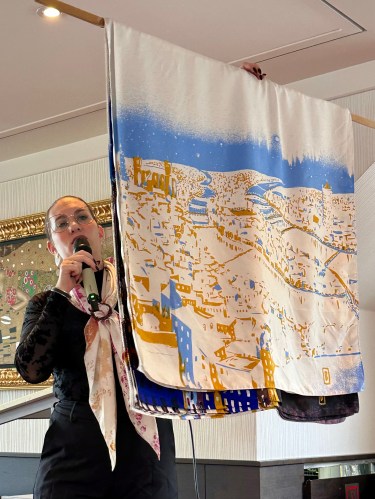
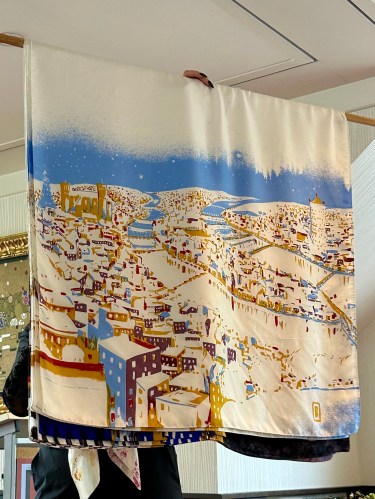
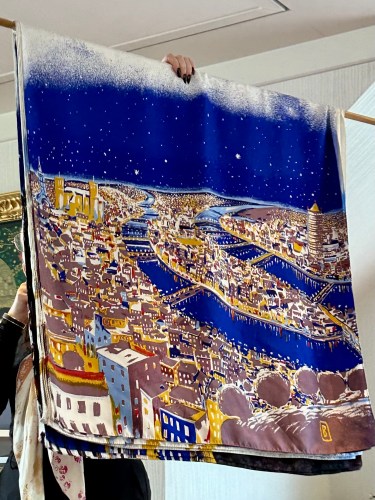
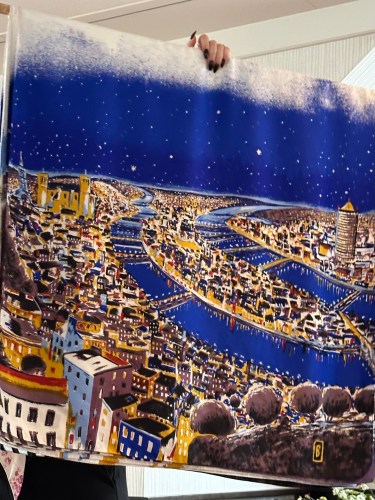
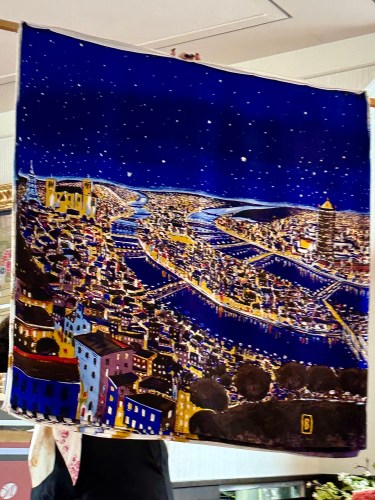
The next day, a woman from Brochier Soieries gave an onboard presentation on silk weaves, and printing on silk fabric as we cruised to our next destination. Screen printing is done in layers of color. This scarf depicts the city of Lyon: the Saône and Rhône rivers, and Presqu-ile, the peninsula in between.

She also discussed block printing, and machine printing. Machine printing isn’t necessarily faster; it can require one pass for every warp thread.

I learned a lot, and may have purchased a scarf. I was thrilled to have another textile tie-in on this trip!

More learning on this cruise: This AMAWaterways sailing was co-branded with Smithsonian Journeys. We had two art historians on board, Amanda Luyster and Stéphanie Jeanjean, who each gave two lectures. They covered the period between first century AD up to contemporary art. This added a lot to my understanding of the sites we visited.

More later!

Aura e-book winner, Chinatown exhibit in PDX

Trellis Vines Stole Poncho

Stole vs Poncho: The readers have spoken! It sounds like it was a good idea to hedge my bets and have Trellis Vines be wearable both ways. I am currently wearing mine as a poncho, but glad to have the flexibility to unlace it later. I do love how ponchos stay on my shoulders.

Thanks to everyone for commenting. Random.com has spoken, and the 29th commenter is the winner of the Aura e-book! I’ll send Juanita an email to let her know.

I went with my mom and one of my sisters to the Oregon Historical Society to see the exhibit on Portland’s Chinatowns. I didn’t know that the first Chinatown was on Southwest 2nd Avenue; I thought it was always on the North side of Burnside where it is now. Lots of interesting artifacts and pictures. We even saw Mom’s grandmother in a picture of the Portland Chinese Women’s Club Anniversary Celebration from 1948. Cool! The exhibit runs through June 21. Admission is free if you’re a Multnomah County resident, and not a lot if you’re not.

grandmothers

Speaking of grandmothers, here’s a picture that has both of my grandmothers. It was taken at an event in 1938 or 1939. The Chinese community was protesting the sale of US scrap iron to Japan before the US entered World War II. Lily Lee on the left, Violet Wong on the right. (Lee Chan Shee, family friend in the middle.) There were other pictures from this event in the Chinatown exhibit. It was interesting to be able to place this family photo in historical context, and even more interesting to see family members as activists!

It’s been a busy few days. How was your weekend?

History Unwound, the first

Earlier this month, I spent a weekend across the continent in Colonial Williamsburg, VA, for the very first History Unwound retreat. History and textiles? Definitely up my alley! It was an amazing weekend from start to finish. (Super long post, but worth it.)

It began with check in, and an incredible goodie bag.

history unwound goodie bag

I had an hour to make a quick zip through Colonial Williamsburg, so I went to see the textiles in the museum. They were having a special hour where you could look in the drawers at the textiles not usually on display. The sampler collection was in this room.

colonial sampler

I asked if they had any knitting, but alas, no. Lots of samplers and quilts. But lo and behold, look what I found in one of the drawers? Probably the only knitting in the museum! (The lights are kept very low in this room; sorry for the dark pictures.)

needlework sampler book

This is in a needlework sampler book from Ireland. Let’s look a little closer:

knitted lace edgingsSome knitted lace edgings, and a tiny baby bootie made for a china doll.

needlework sampler bookA tiny hat sample, and some double knitting and elastic knitting (ribbing). Cool!

Then it was time to head back for the opening dinner and lecture with Franklin Habit. His lecture was titled “B is for Purl: A Brief History of the Knitting Pattern.” Really interesting. Apparently knitting patterns as we know them didn’t really exist before the 1800’s. The talk was so engaging, I swapped my Saturday afternoon class. More on that later.

On Saturday my day started with brunch with Anna Zilboorg. I think more people had signed up than actually came, so it ended up like this.

breakfast with Anna Zilboorg

Sweet deal! She talked about the history of Women’s Work, and making the necessary beautiful.

My morning class was with Franklin Habit: History, Methods and Styles of Lace Knitting. He gave us a knitting tour of Russia, the Shetland Islands, and Estonia, and had many gorgeous samples, including this Estonian beauty.

Estonian Lace Shawl

We knit samplers while we listened. My first nupps! Not scary at all.

my first nupps

Rohn Strong talked about the role of knitting in the Civil War during a brown bag lunch. Good history, good knitting!

I was supposed to learn Double Knitting with Annie Modesitt in the afternoon, but I was so intrigued by Franklin’s presentation the night before, I asked if I could transfer to his Working with Antique and Vintage Knitting Patterns class. Yes! And it was great. Part lecture, part hands on, all perfect. There were only 7 students in class, and we worked in teams to try to figure out how several objects were made. This was my team’s puzzle:

pence jug

pence jug bottom

I won’t tell you where it starts and ends, in case you take this class yourself. But if you want to make this treasure from 1843, you can find instructions here. Franklin writes a column, Stitches in Time, for Knitty.com, and all the samples he brought have been in Knitty. I went back and read them all. He’s good!

The other class project was a mystery knit. We translated the instructions from 1870’s format to modern day, and knit. It turned out to be something recognizable, thankfully. No picture, so you can take this class and be surprised. I have an idea to make something with this little thing; we’ll see if it happens.

After class there was a lecture on Balkan socks by Donna Druchunas. (The fun never stops! So much activity. So much to learn!)

Balkan socks Donna Druchunas

She had a lot of samples, which we passed around the room. Look at the toe on this one!

toe detail balkan sock

Then it was time for the pizza and pajama party. I was too tired to go back to my room for pj’s, so I just winged it. That’s a lot of activity (six events) in one day after flying a red-eye the day before. And there was more to come on Sunday.

I started Sunday morning in a class with Anna Zilboorg, Embroidery Enhanced Sweaters. So much beauty in this pile. These are in her upcoming book, Splendid Apparel. We’ll be receiving copies of the book as a treat from History Unwound. Looking forward to it!

Anna Zilboorg sweaters

Embroidery can make already beautiful textures really sing.

Anna Zilboorg embroidered sweater

Anna Zilboorg embroidered sweater

Here’s my sampler:

knit embroidery sampler

I’m looking forward to embellishing some knits, but don’t know that I will be able to put it into design work. It would be a lot to explain…we’ll see.

After class was a brunch where Anna talked about Socks Throughout History. And in the afternoon I attended Franklin’s lecture, Impractical Oddities and Curiosities of Weldon’s Practical Needlework. Franklin is a wonderful lecturer and teacher, the best I’ve encountered. And I’ve taken a LOT of classes. Go see him if you ever have the opportunity. I took his photography class at Sock Summit II, and was very impressed. I took a class with Anna Zilboorg at a Stitches event in the 1990’s, and she changed my color knitting life. For these two teachers alone, I took this cross country jaunt. Everything else was a bonus.

But wait! It wasn’t over yet. Donna Druchunas gave the final closing lecture. She shared her collection of Lithuanian mittens. These are just a few.

Lithuanian Mittens

What a weekend! On top of that, I met friends old and new in person.

vtknitboy chris and pdxknitteratiChris

fibretown emilyEmily

Donna Druchunas and nekomichDonna and Mich

michelleMichelle

franklin habit pdxknitteratiFranklin

anna zilboorg pdxknitteratiAnna

And I won a boatload of door prizes, too.

Lion Yarn Book
Lion Brand Collection Silk Mohair, very similar to Kidsilk Haze. Yum. And this reprint of the 1916 Lion Yarn Book. Now I have vintage patterns to decipher, too. And I know how.

door prizeMore yarn, and doily patterns.

Ken McNeill art

Ken McNeill art

Original artwork from Ken McNeill. He was at the market, and was both talented and charming. Oh, I didn’t mention there was a market? Carefully curated, and full of temptation. I held myself to this pretty single ply fingering yarn from Knit Wits. It’s Periwinkle Sheep, color Stones Dancing in the Fog.

stones dancing in the fog

Also from Knit Wits, screw on buttons from Jul Designs. I’m thinking of using them for shawl pins, but I don’t know yet.

Jul button

A lot of activity packed into one weekend! History Unwound was developed by Kimberly and Christopher Villareal. It was delightful, if not restful. I loved every moment, and would do it again. Have I made you want to go on retreat? Or did I just make you tired? I’m guessing a little of both!