Category Archives: pattern design

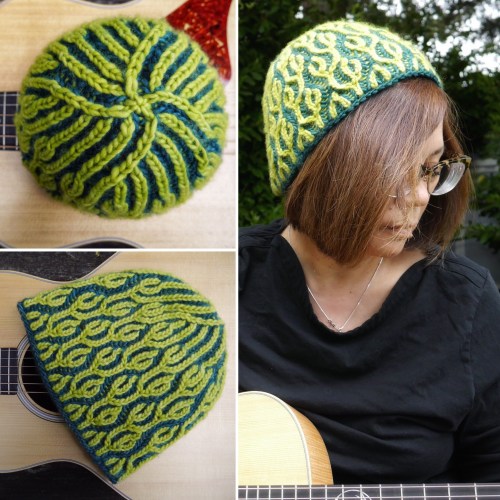
Goldilocks hat, Take 3: Success!

Knowing all that I learned from the two previous hats made this an easy knit for me. The yarn is Anzula For Better or Worsted, 80/10/10 superwash merino, cashmere, and nylon.

A quick selfie for proof of concept. It fits the way I want it to. Now to work on a cowl version for non-hat wearers.

It’s coming along nicely. I’ll also need to work up a smaller version of the hat. And two options for crown shaping, too. So many options for this class project!

I’m writing the pattern in modular units (chart and written instructions) for each motif. And I’m trying to decide for the charts: a separate chart/page each for small hat, large hat, and cowl? Or just chart the motifs with instructions on how to set it up? That would take fewer pages, and that’s how I want to do the written instructions to avoid a 15 page pattern. It’s pretty obvious which motif you’re working, based on stitch count between markers. What do you think?

Onward!

Goldilocks, Take 2

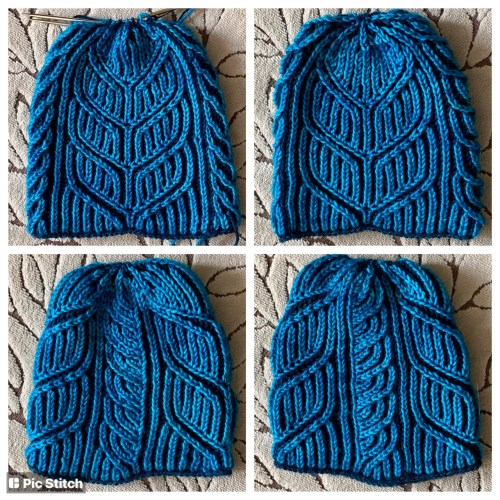
To make the hat shorter? I made the whale tail taller, so I could use fewer repeats. From 3 tails to two. They have more visual pop, too. I put the whale tails on both front and back; that’s visually pleasing.

I added waves to each side of the whale tails. From one side the waves are breaking towards the tail, and from the other side they’re breaking away. Symmetry!

But I don’t like the waves being vertical instead of horizontal; they’re perpendicular to the whale tails. Nope. That’s not how whales swim. (You’d think I would have thought of this while knitting an entire hat, but nooooo.)

On to Take Three!

Goldilocks hat syndrome

I’m designing a hat for a class I’m teaching on the Vogue Knitting Cruise at the end of August. It’s a quickstart brioche class, with brioche rib, increases, and decreases.

Brioche Pastiche

I usually use Brioche Pastiche to teach a class like this. It’s a lovely hat, and it does teach all the thngs you need to know, but we don’t get to the right leaning decreases until late in the class, and I’d like to have more practice time before sending students off.

When I teach increases and decreases separately from brioche rib, I use my Deep End hat or cowl, or Madrona Cowl.

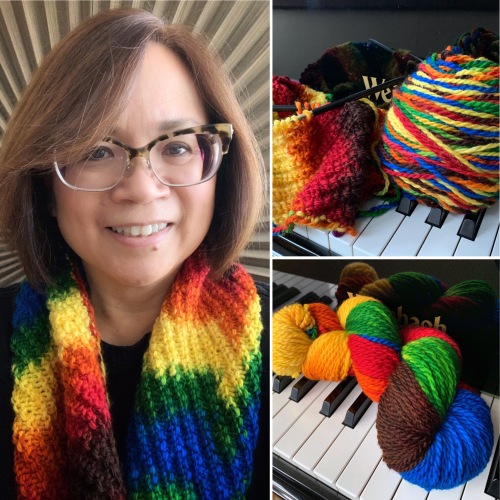
Deep End and Madrona

But those don’t start with brioche rib, so they’re not quite right for the 3 hour class, either.

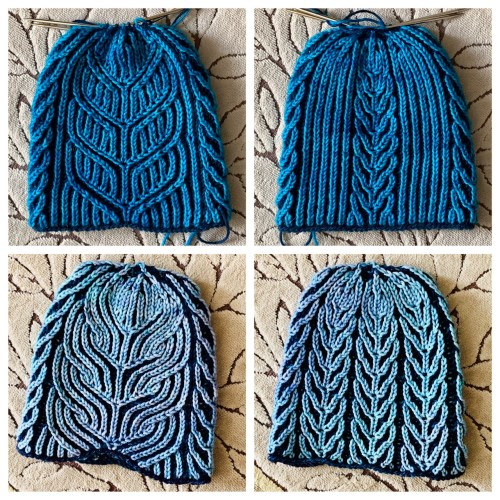
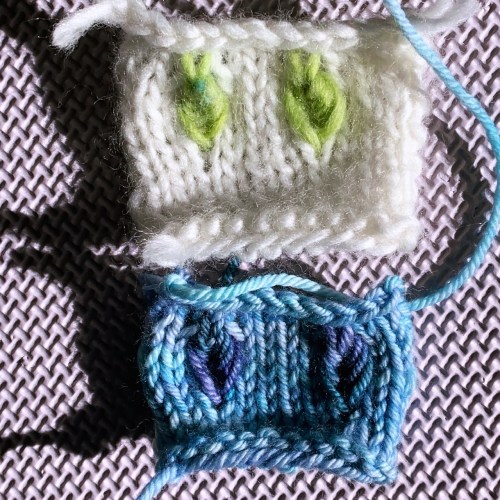
New hat above, Deep End below

Piece of cake, right? I’ll design a hat with a whale tail motif (how nautical), beginning with brioche rib, and then working into increases and decreases. And! I’d make the back with a choice of all gulls like Deep End, or a mix of gulls and plain rib, so there’s not as much to overwhelm a new brioche knitter on the first patterning round. The stitch count is the same as for Deep End. Why, this hat would practically design itself. Sounds great!

Massive fail. the hat is enormous, because the plain rib is much wider than the gulls, over the same number of stitches. And it’s a little too tall, too, because of the added brioche rib at the beginning.

Back to the drawing board. I’ll be back…

Introducing Cosette

Cosette

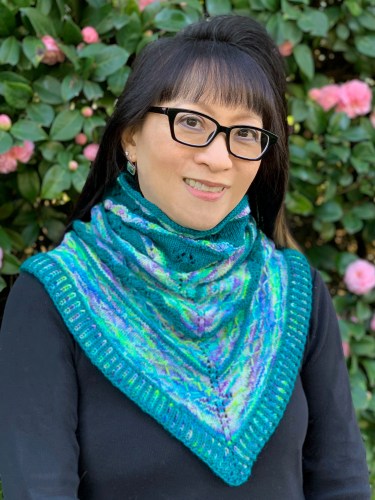
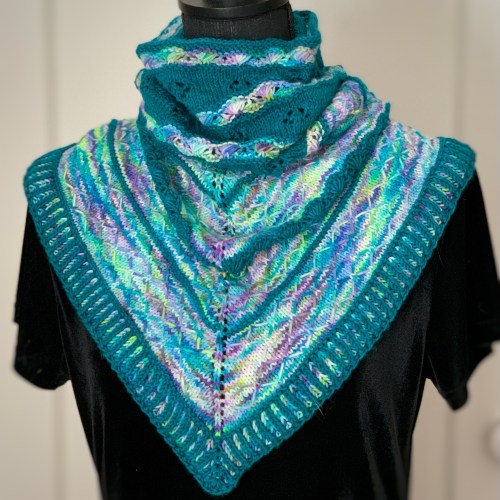
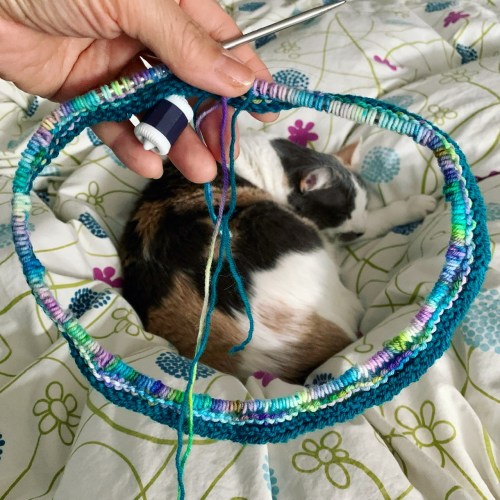
Cosette is a cross between a cowl and a shawlette. A cowlette? It starts out as a round cowl, knit from the top down. After the cowl is finished, knitting continues with triangular shawl shaping in the round. This cowl/shawette combo provides great coverage, and it won’t slip off your shoulders! It’s fuss-free wear.

Here’s Cosette in its unscrunched glory. I really love how this turned out, and I enjoyed all the mathy bits that made it work!

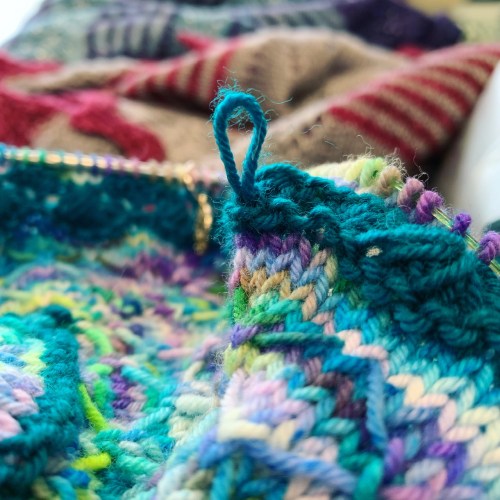
Cosette is knit with 2 skeins of fingering weight yarn. I used Knitted Wit Sock in Kiss and Teal and The Future is Bright (variegated). I love how the quilted lattice stitch shines in a variegated yarn. Other stitches in this pattern include my favorite lacy flower, and a shell lace stitch that uses elongated stitches with extra yarnovers that are dropped on the next round. There’s a video tutorial for the shell lace stitch.

Cosette ends with either brioche rib or k1p1 ribbing; it’s your choice. I love the way the contrast color peeks through the brioche rib. There are brioche video tutorials linked in the pattern, too.

The Cosette pattern is available through my Ravelry shop here, and my Payhip shop here. Use coupon code QUILT for 15% off through April 14 in either shop.

Thanks to tech editor Meaghan Schmaltz, model Sharon Hsu, and test knitters Ann Berg, Debbie Braden, Karen Cunningham, Jesse Hodgden, Jacqueline Lydston, Marilee Reinhart-Davieau, and Andrea Roosth.

Happy knitting!

On the needles

Cosette is finished except for the publishing. I’ve also knitted three versions of another design for a June release (no pictures yet). My needles were empty, so it’s time for another project! I’m designing a new hat/cowl project for my class on the Vogue Knitting cruise in August. (Come cruise with me!)

Look at the color of that water. It inspired me to choose this yarn.

Mmmmm, Malabrigo

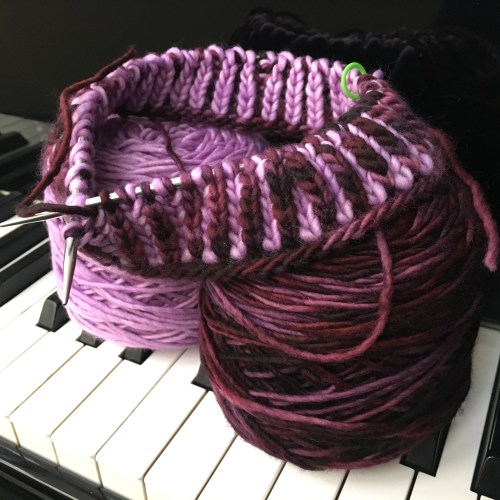
This is Malabrigo Rios in Azul Profundo and Cian. So pretty! My class is a brioche class, and I’m trying to make it as user friendly as possible. It’s just a 3 hour class, so I have to think about pacing and how to cover everything I want. (You may be thinking about my Deep End hat and cowl, but that’s too much of a quick start for brioche newbies.)

I have this design all planned out, and now I just have to knit and see if it really does what I want, at the pace I want. Wish me luck!

Coming soon: Cosette

Cosette is a cowl that didn’t stop when the cowl was done. It continued on into a triangular shawl shape so I could use more of this pretty variegated yarn from Knitted Wit. That’s the yarn that called my name first! It took me a while to figure out how to let it shine best. I think I’ve got it.

The edging is brioche rib, but there’s an option to work the edging in K1P1 ribbing instead. Brioche rib is just glorified ribbing, right? The whole thing goes over your head like a cowl, but looks like a shawlette when it’s on. And it doesn’t fall off. This is my new favorite shape, a mashup of cowl and shawl.

I’m looking for a few test knitters. Let me know if you’re interested! You’d need 2 skeins fingering weight yarn in contrasting colors, and I’d need you to finish in about 2 weeks? Three weeks max. This one just flew off my needles.

We’ve come a long way from this little mishap!

I woke up from a dream the other morning, with three design ideas in my head, but could only remember two of them when I wrote them down. I’m on a roll, though…still can’t get excited about doing my 2021 bookkeeping, though! I do need to finish that. Soon.

Introducing: Camellia Wrap

I’ve been working on a project for Knit Picks IDP (Independent Designer Partnership) program. They’ve begun doing monthly IDP showcases, and I applied to feature my Cherry Blossom Wrapture for their March “green” showcase. This meant that all I needed to do was to knit a sample in Knit Picks yarn. Easy, right?

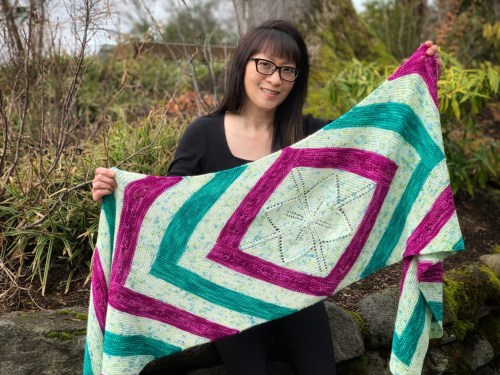
The colors I chose didn’t want to play along. I think the stronger colors I chose required a simpler, less busy layout. I ended up writing a new pattern, Camellia Wrap. Camellia Wrap is a streamlined version of Cherry Blossom Wrapture. It’s simpler in that there’s just one way to lay out the colors, and there’s only one lace motif for the logs. I did all the thinking so you don’t have to; you just get to knit!

I chose the name Camellia Wrap because I envisioned photographing the wrap in front of a friend’s camellia hedge. Apparently the hedge didn’t want to cooperate either; it will probably be in full bloom in mid-March. See the single blossom above Sharon’s head?

The pattern is available for purchase through the Knit Picks Independent Design Partnership here.

The pattern is also available for purchase through Ravelry downloads, link here.

The pattern is also available through this link to my Payhip store, link here.

On Ravelry and Payhip, you can use the coupon code blooms for 15% off your purchase.

If you previously purchased Cherry Blossom Wrapture, you can get the Camellia Wrap pattern for free! I sent out an update to previous buyers with a special code.

pdxknitterati rosaria

In case you’re wondering, this is what the camellia hedge looks like in full bloom. This is Rosaria, my design for the Rose City Yarn Crawl Mystery KAL in 2014. I was working with Knit Picks for a March 1 launch, so I couldn’t wait for the mass bloom effect. Maybe later…

Just keep knitting…

Swatching, charting, knitting

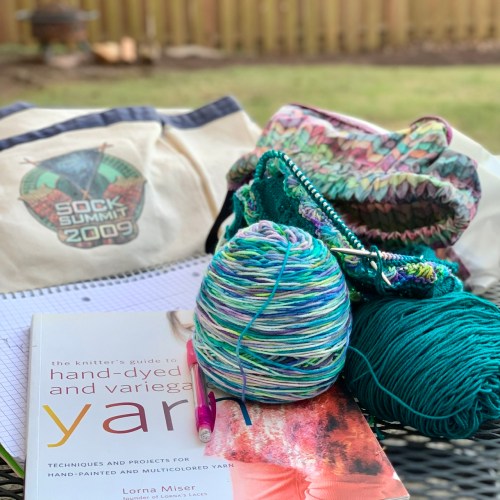
It was a splendidly beautiful day yesterday; it got up to 67 degrees F (19 C); which is unusual for February in Portland. I took my work outside. My math swatch has paid off, and I’m done with the first section of my new design. The next step required some charting and planning to make stitch counts work out on the repeat (do you sense a theme here?). I want to alternate the variegated and semi-solid, and give the variegated yet another chance to sing. This yarn is Knitted Wit Sock in The Future is Bright and Kiss and Teal.

The book on the table is Lorna Miser’s The Hand Knitter’s Guide to Hand-Dyed and Variegated Yarn. It talks about different dye methods, and how to make the most of them. A lot of the book is about how to recognize if colors will pool, and how to avoid pooling, if desired. There are lots of stitch patterns to play with. I’ve swatched the one that it will be perfect for this project. We shall see.

Sometimes you want colors to pool, and Hunter Hammersen’s Stochastic Hat is an example of that. She worked with Gauge Dyeworks to make a yarn with spaced out color runs, just long enough to knit random color burbles into the hat. (As well as a section to knit a brim all in the contrast color, whoa.) You can use any yarn for this hat, but the thought of knitting it with assigned pooling (the yarn tells you when to make the burbles) is fun.

I was going to knit this hat with Knit Picks Chroma Worsted, but the fuzzy single ply (top) doesn’t want to settle nicely into burbles. The smooth superwash yarn (Malabrigo Rios, below) is much better behaved. I’m not sure I have a hat’s worth in two coordinating colors, though. I’ll poke around a little more. I’m glad I swatched the burbles *before* jumping in and knitting an entire hat brim before finding out my yarn wasn’t going to cooperate! Swatching can be very helpful.

I’m teaching a Zoom class on planned pooling for For Yarn’s Sake on March 6. We’ll talk about planned pooling and assigned pooling. Come knit with me! Register here.

That same weekend I’m teaching Petite Brioche for Twisted (also Zoom). Saturday March 5. If you’d like a jump start into two color brioche in the round, this is it! Register here.

Okay, time to see if my charting made sense, and if my math works out!

Math swatch, Red Alder Retreat

I started a new design with the *real yarn* twice before resorting to a math swatch.

The first time you jump in without swatching, it’s understandable, especially if you’ve knit with this yarn and needle size before. I thought I had the undulating stitch pattern figured out. Not quite. So I started over.

There are four ways to arrange the two stitch patterns, and I need to pick two that will consistently look the same on the repeats.

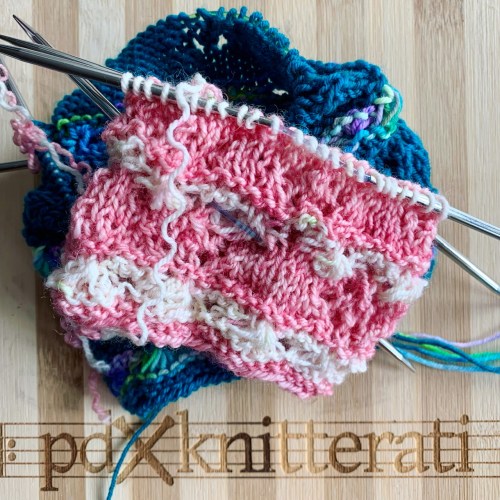
I knit for quite a while before I realized that I still wasn’t going to get the symmetry I wanted. so I finally resorted to a math swatch. Yes, I just made up that term. I didn’t need to knit the motifs completely; I just needed to know if the motifs were going to stack consistently. That’s why this just looks like a jumble of kinky yarn (it was from a piece I had frogged after blocking).

I make the mistakes so you don’t have to!

My classes at Red Alder

I’m getting ready to go to Tacoma, Washington next week to teach at Red Alder Fiber Arts Retreat. There is still room in many classes, so if you’re up for some in-person fun, check it out here. Vaccinations and masks are required. I’ll have a trunk show and book signing with Northwest Yarns in the market; they’re carrying my book, Brioche Knit Love. I’ll confirm times (I think lunchtime Friday and late morning into lunch on Saturday?) and post. Looking forward to it!

Introducing: Brioche Entrée

I love a simple project for teaching a new technique. Brioche Entrée is your very most basic introduction to brioche rib. It only uses the brioche knit (brk) and slip 1 yarn over (sl1yo) stitches, but you still get a brioche rib scarf. No purling needed! I designed this piece to use for a guild presentation, but I’m happy to share it with you.

One skein of super bulky yarn, a pair of US 15/10mm needles, and you’re all set. I used Malabrigo Rasta; this is the Abril colorway.

You can download the pattern here. I made video tutorials for both right hand throwers and left hand continental knitters. I’ve got you covered! This is a simple pattern for brioche newbies, or a quickie pattern for experienced brioche knitters, or both.

Are you a brioche knitter? Am I tempting you to try it? Get it off your bucket list!