
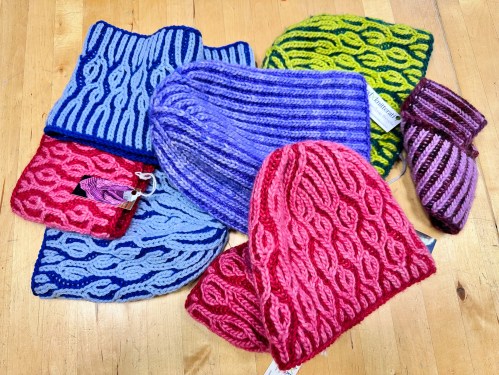
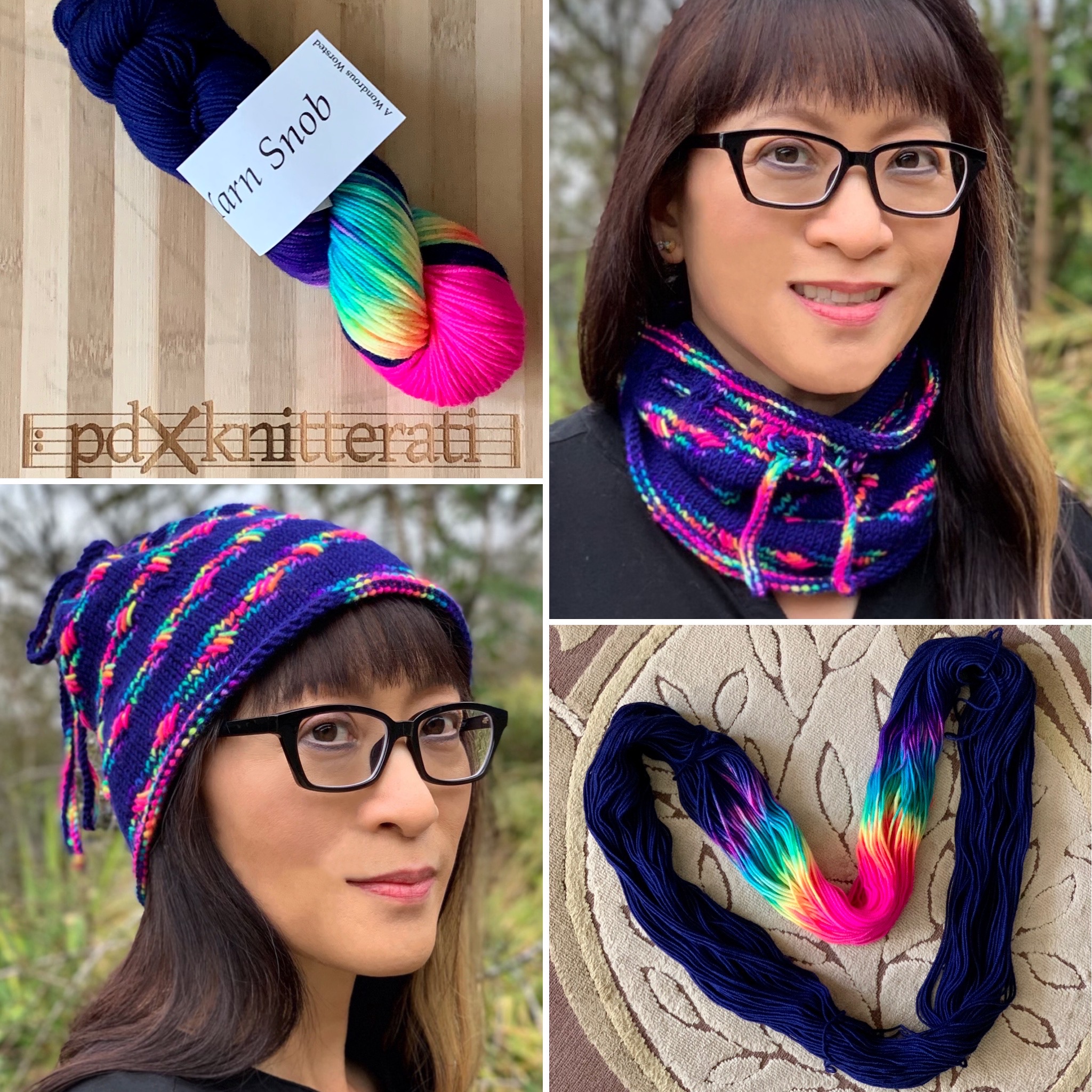
I taught two classes this past weekend. One was Brioche Pastiche, beginning brioche, at For Yarn’s Sake. So busy that I forgot to take a picture! So here are my samples of the various things you can knit with this pattern: Cowl or hat, plain or fancy, or somewhere in-between! Picture taken at the end of class.
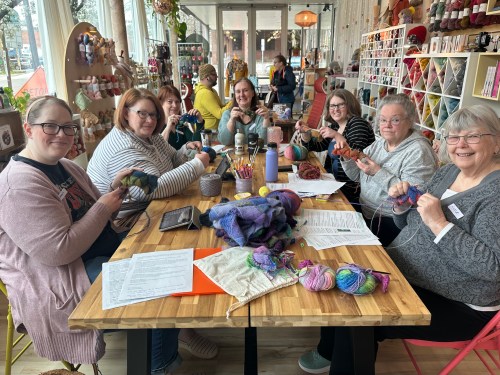
I also taught an entrelac class at Hook and Needle.
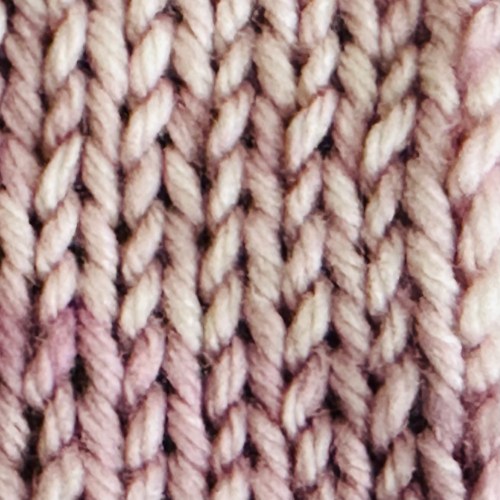
Entrelac is just a series a small stockinette squares or rectangles. It’s a good opportunity to evaluate your stockinette stitch! Does yours look like this?
or like this?
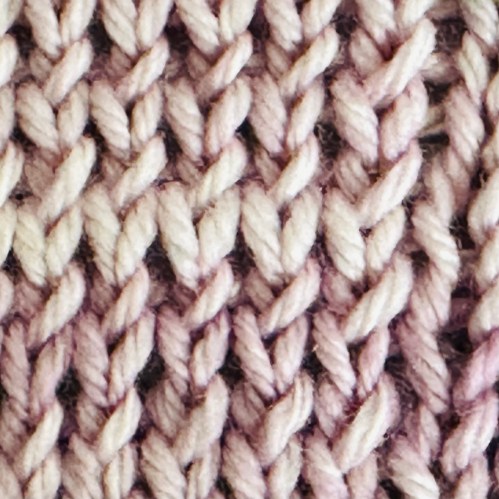
In conventional Western knitting, stitches sit on the needle with the right (leading) leg in front. In Eastern knitting, stitches sit on the needle with the left (trailing) leg in front. In either case, to keep your stitches open, not twisted, you work the stitches going into the open loop, not twisting them.
What makes your stitches sit on the needle with the right or left leg in front? It’s how you made your stitches in the previous row or round. If you wrap your stitches counterclockwise, the stitches will be mounted with the leading leg in front (conventional knitting). If you wrap your stitches clockwise, your new stitches will be mounted with the trailing leg in front. Do you mix it up? In Eastern Combined knitting, knit stitches are wrapped counterclockwise, and purl stitches are wrapped clockwise, resulting in a mix of stitch mounts.
Do some of your knit stitches have a little cross at the bottom of the V shaped stitch instead of being open? Do you want that crossed stitch? It does make your knitting tighter. But if you want it, you’re set. As long as you get the result you want, you’re doing it right! If you don’t want that cross, read on.
If you’re an Eastern Combined knitter and some of your stitches are twisted, and you’d like your knit stitches to be open at the bottom instead of twisted, you have two choices. You can change the direction of your purl, which would be conventional Western knitting. Or you can continue to wrap your purls the same way, but change how you enter the stitch on the next row or round.
Here’s a little video to show you how.
One more thought: If you wrap both your knits and purls clockwise, you’re an Eastern Uncrossed knitter. The principle is the same. As long as you work into the open stitch (not making it cross when you enter it), your new stitches will be fine. You just need to know how to work them on the following row or round.
How do you knit? English, right hand carry? Continental, left hand carry? Western? Eastern? Eastern Combined? Interestingly, four of my eight entrelac students were Eastern Combined knitters, some English and some Continental. One knew how to untwist her stitches already. The other three learned a new thing, besides entrelac.
Again, as long as you get the result you want, you’re doing it right. And if you’re mid-project and want to switch, wait until you’re done because it will definitely show.
Knit on, my friends!




 PDXKnitterati